
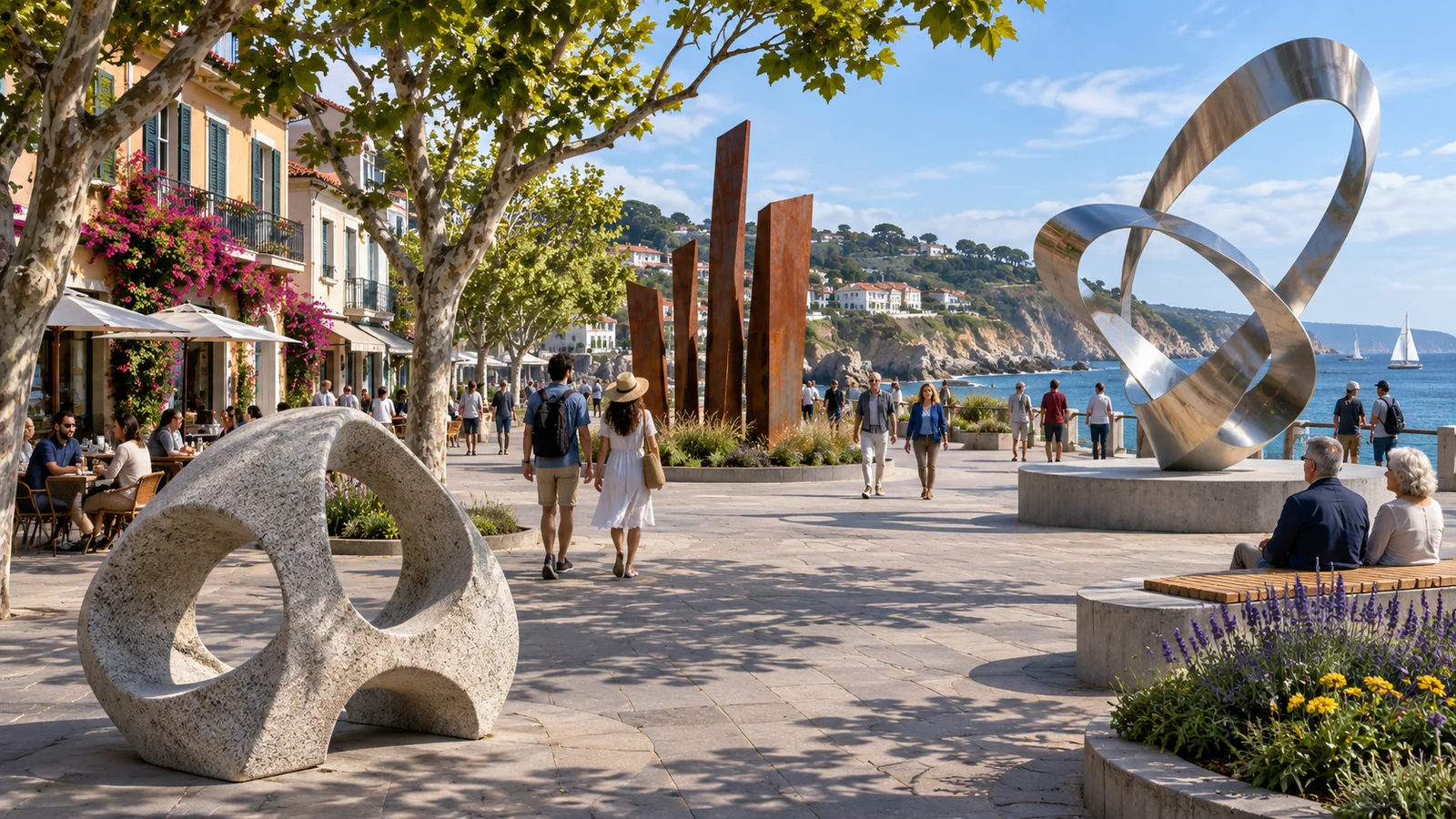
Start a Campbell River public art walk at Spirit Square, beside the Campbell River Art Gallery. Follow Shoppers Row towards 11th Avenue and look for murals, artist plaques and other artwork visible from the sidewalk. Add the waterfront if you want to see how artists have used local landscapes and working boats as subjects. For a separate stop, visit Campbellton’s River Nook or the Raven Park entrance. City of Campbell River Spirit Square · City of Campbell River downtown initiatives · Campbellton Neighbourhood Association
Start at Spirit Square
Find Spirit Square at Shoppers Row and 16th Avenue. The city places it beside the gallery and across the street from the Tidemark Theatre and the library. Look up to see Logger Mike on the spar pole, then look at how the square is arranged around the places people gather. The city describes it as a public event space with performances, markets and other activities. Check whether anything is scheduled before you go, especially if you need a quieter place to spend time or a particular approach from parking.
The square sits on the territory of the Liǧʷiłdax̌ʷ people of Wei Wai Kum and We Wai Kai First Nations, as the city’s page explains. If you see an artwork or a name you don’t recognize, look for its attribution before guessing at the story. Make a note of the artist, title or Nation named on the sign so you can look it up later. Give the people using the square room if there’s a performance or gathering.
The Campbell River Art Gallery at 1235 Shoppers Row gives you a place to start or finish indoors. Its exhibitions change, so check the current list and hours. The gallery lists wheelchair access to the Centennial Building and an accessible parking space at the rear. Check with the gallery if you need further details. Use the exhibition as one part of the visit and decide whether to walk before or afterwards based on opening hours and the weather. Campbell River Art Gallery hours and access · Current exhibitions
Follow Shoppers Row towards 11th Avenue
The city’s downtown initiative describes murals, painted or wrapped utility boxes and artist plaques. Some public art changes over time, so start with features documented by the city and use what you can see from public sidewalks. At 11th Avenue, the city’s 2017 annual report records Alex Witcombe’s mural project on a wall facing the street. Look at the corner from a public approach and check for posted attribution. If a wall is obscured by work or a display has moved, continue along the sidewalk and make the next available work your stop. City of Campbell River 2017 annual report
As you walk, notice how the setting changes your view. A high wall can be seen from across a street, while a small work on a utility box or plaque can be easy to pass. Stop at the right distance to see the whole work before looking more closely. Use marked crossings and stay out of driveways and private lots. If you want to take a photo, leave room for other people to pass and check whether a sign asks visitors to observe a particular rule.
The City’s 2016 annual report identifies a Canada 150 Mosaic Mural at the downtown Community Centre. It credits artist Curtis Wilson, mosaic artist Lewis Lavoie, the City’s Public Art Committee and hundreds of residents. The mural includes Discovery Passage, the Cape Mudge lighthouse, a Tyee rowboat and a salmon design by Wilson. Ask the Community Centre to confirm the work’s current location and public access before making it a stop. If you see it, look at how the small tiles work together to create the larger scene. City of Campbell River 2016 annual report · City of Campbell River indoor facilities
Add the waterfront if you want another view of the same place
From Shoppers Row, use the city map to find the public route to Robert Ostler Park or Discovery Pier. Robert Ostler Park has benches, washrooms and a playground. It can be a practical turnaround if someone needs a rest. Check the city’s Seagull Walkway project information if you plan to use that connection towards the Government Wharf. Choose another public route if it is affected by work. City of Campbell River maps · Robert Ostler Park · Seagull Walkway project
Discovery Pier gives you a view across the passage and along the working waterfront. Use it to compare what you saw in a mural with the setting itself. Notice which features the artist made easy to recognize. A lighthouse, outline of a shore or type of boat can place a scene even when the work uses colours or shapes you wouldn’t see on a given day. The pier is beside the Government Wharf, Discovery Passage Aquarium and Maritime Heritage Centre, so choose a specific meeting point if part of the group will come straight to the waterfront. Destination Campbell River Discovery Pier
Use Campbellton as a separate riverside stop
The River Nook is a small park on the east side of the Tamarac Bridge. The Campbellton Neighbourhood Association describes it as a public riverside space with art. Artist Alex Witcombe’s public art listing identifies his driftwood sculptures of spawning chinook salmon and a black bear cub at the River Nook. Check the association’s directions and use public paths to reach it. Look at how the shape of the driftwood contributes to the form before looking for the details that make an animal recognizable. Campbellton Neighbourhood Association River Nook · Alex Witcombe’s public art listing
The association also identifies an Indigenous-led archway and carved bear at the Raven Park entrance, crediting Bill, Greg and Junior Henderson of Wei Wai Kum First Nation. Treat the entrance as a place to read about the work and consider its setting, with the trail and the estuary nearby. Use the association map and the city’s current parking directions if you want to include a walk. A separate Campbellton visit gives you time to see the riverside works without stretching the downtown walk beyond what suits your group. City of Campbell River parking update for Baikie Island
Make time for the artists’ names and accounts
The Museum at Campbell River’s Q̓ay̓ola exhibition page describes a project about Indigenous public artworks in the city. It credits a partnership with We Wai Kai and Wei Wai Kum Nations and collaboration with the Liǧʷiłdax̌ʷ Research Centre. Use the museum page as background and check whether the exhibit is available for your date if you want to see it in person. In the museum, follow its photography rules, including the prohibition on photographs in the First Nations Gallery. Museum at Campbell River Q̓ay̓ola exhibition · Museum at Campbell River visitor FAQ
When you find a public piece, look for the artist’s own account of it if there is one. Compare what you first noticed with the setting or idea the artist describes. A sculpture near the river, a work made with community-painted tiles and an exhibition in a gallery give you different ways to see how art reaches an audience. Choose one work for a longer look and give the other stops enough time to read their signs. If you share a photo afterwards, use the name and credit you recorded.
Plan the walk around another Campbell River outing
If you’re booking a wildlife tour, start with the check-in time and location. Eagle Eye Adventures offers a four-hour marine wildlife tour and lists Coast Marina as its Campbell River office. Choose the short Spirit Square and Shoppers Row walk before boarding if the timing fits. A visit to the gallery or Campbellton may fit better afterwards or on a separate day. Give yourself time to get to Coast Marina with what you need for the boat. Eagle Eye Adventures marine wildlife tour · Eagle Eye Adventures contact and location
Can I do the walk when the gallery is closed?
Yes. Spirit Square and art visible from public sidewalks can make a short outdoor visit. Check city notices and use open routes. Save the gallery and any art inside another building for a day when you’ve confirmed access.
What should I choose with children?
Pick one large work to look at together and another stop where everyone can take a break. Ask children to describe the materials and look for the artist’s name. If they want to see driftwood animals, use the River Nook as a separate stop. Stay on the path and give the work room.
Choose a route you can enjoy at your own pace
For a short downtown visit, spend your time at Spirit Square and the blocks towards 11th Avenue. Start with something the group can see easily and choose the next stop once you know how long people want to look. If the gallery is open, decide whether you’ll spend the last part indoors. An outdoor walk and an indoor exhibition ask for different kinds of attention. Give people a break between them if you’re travelling with a group. Use the gallery as a clear meeting point if part of the group wants to spend longer outside.
With a half day, include a stop at the waterfront or go to Campbellton after the downtown walk. Choose the waterfront if you want to compare an artwork with the view of the passage or look at boats around the wharf. Choose Campbellton if you want to see sculpture set beside the river. If everyone is walking, check the distance and route to the second location before committing to it. The river stop may work better with a separate ride or more time. Take a map and pick a landmark for the return.
If you’re visiting in mixed weather, start with the destination that has fixed hours and use the outdoor stops in a drier window. Compare the route to the entrance with the facilities you’ll need. Someone who wants to stay longer at one artwork can have time for it if the group knows where to wait. A small notebook or a phone can keep the artist names and locations together without needing to stop at each one for a long time.
Look at the materials as well as the subject
At a mural, look at what the artist needed the wall to do. The work may use windows, the shape of the building or the way a viewer approaches from the street. At a driftwood sculpture, look at where a single piece of wood forms a curve or how several pieces suggest movement. At a mosaic, step back to see the picture, then look at a small area and see how individual tiles make that part of it. Each material changes what you see close up and from a distance.
If you have children with you, ask them to pick an artwork they would notice again from farther away. Let them tell you why they picked it before you read the sign together. An adult can choose another work based on a connection to the shoreline or local history. Compare the two choices at the end. The walk can be short and still give each person a chance to look at something they’re curious about.
If a work you came to see has moved or is behind temporary fencing, look at the site from an open public area and choose another stop. Make a note of the title and location you expected so you can check with the venue or artist later. Temporary exhibitions, murals and outdoor sculpture can change on different schedules. A route with two or three points of interest gives you time to look for what’s available without walking much farther than you planned or losing time for another outing. It also gives you a reason to return when a gallery, site or event next offers a work you want to see.