
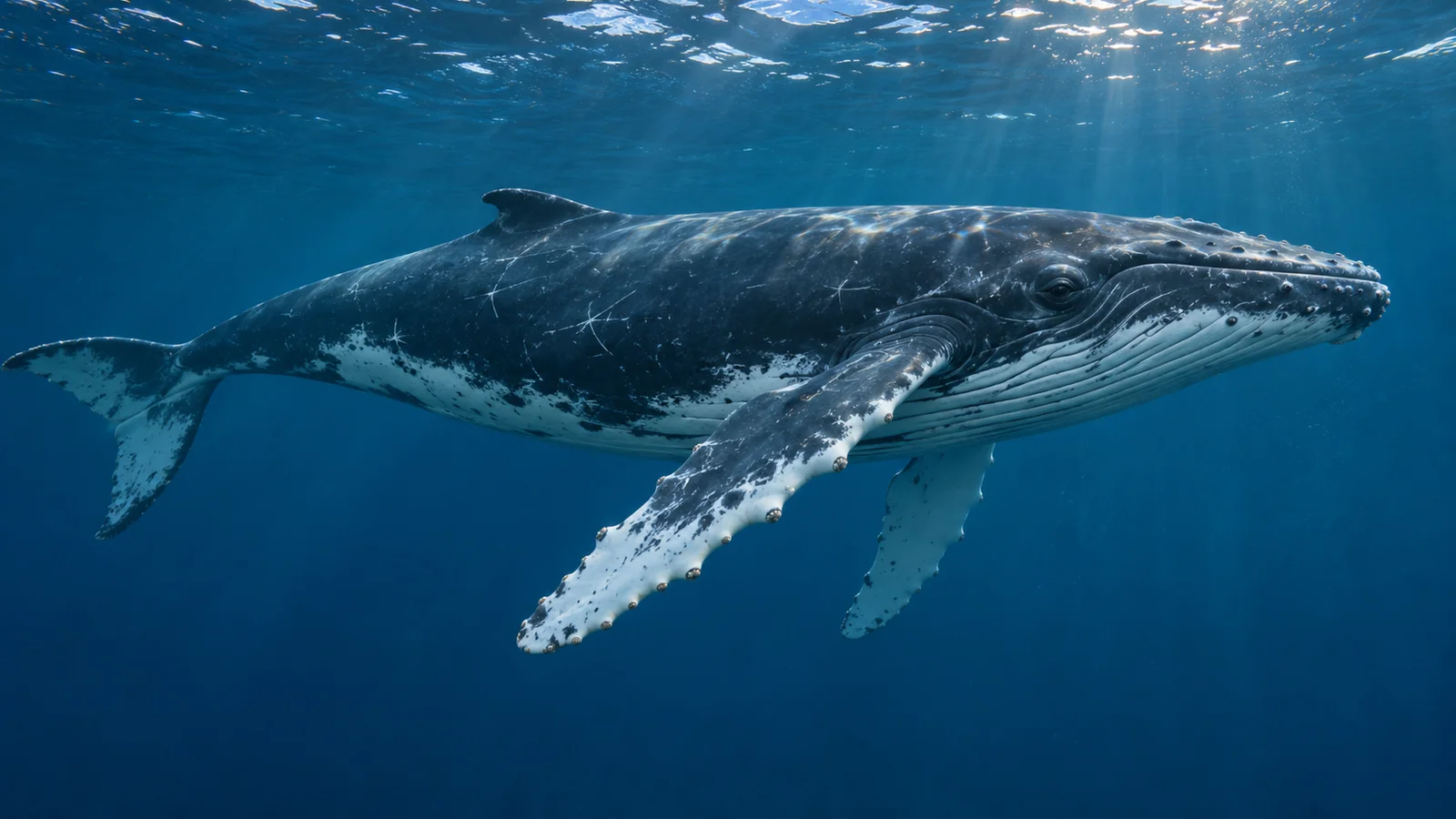
A humpback whale feeding on a school of fish takes in the water around its prey as well as the fish. Its lower throat expands during the gulp, then the whale narrows its jaws and expels water through baleen. The baleen plates and their fringes help hold prey in the mouth until the whale swallows it. If you see a humpback lunge near the surface off British Columbia, the open mouth may draw your eye first. The changing shape of the throat and the moments after the jaws come together tell you more about how the animal separates a meal from the water.
What baleen looks like in a humpback
Rows of baleen plates hang from the upper jaw of a humpback. The plates are made of keratin, the same broad class of protein found in human hair and fingernails. Fringes on their inner edges form a filtering surface. When the whale expels water after a gulp, the structure helps keep prey in its mouth. An open-mouth photograph may show the plates as repeated dark shapes along the upper jaw, but angle, shade and distance can make the fringes difficult to see. NOAA humpback whale profile · Research on filtration in lunge-feeding whales
Baleen works along the sides of the mouth. A person looking straight into an open mouth may notice the tongue, the roof of the mouth or the shape of the jaws first. A side view can help show where the plates hang relative to the gap between the jaws. Those views document the same anatomy from different angles. A drawing or labelled photograph can help you recognise the parts in your own pictures later.
The plates are part of a feeding system that includes the jaws, tongue and expandable lower mouth. Each part contributes at a different point in the sequence. The jaws admit a large volume of water, the lower throat expands to hold it and the baleen helps retain prey during expulsion. Looking at only the baleen would leave out the mechanism that puts water and prey in contact with the filter. Review of rorqual lunge feeding
First the whale has to take in the prey
A feeding lunge begins before the whale opens its mouth. It moves toward a patch of prey, which might consist of krill or small schooling fish. Research using motion records from humpbacks has helped describe the approach, the timing of tail strokes and what happens to the whale’s speed during and after engulfment. Those movements are significant because the animal is taking in a large mass of water as it moves. The water has to be accelerated along with the body during the gulp. Humpback lunge-feeding motion study
Prey density can make a large difference to the amount of food captured. A large gulp from water with very few fish can contain less food than a smaller gulp through a dense school. Humpbacks can take advantage of prey gathered by local conditions or by the actions of predators. They can also use behaviours that help concentrate prey before the lunge. The mouthful works best as a feeding opportunity when the food is where the whale can reach it.
A surface lunge may be vertical, oblique or accompanied by a roll. The important thing for understanding the filter is the sequence that follows. A whale takes water and prey into an expanded mouth, closes its jaws most of the way and expels the water. If you see the lunge at the surface, try following the changing shape of the body instead of focusing on the splash alone.
What the throat pleats do during the gulp
Humpbacks belong to the rorquals, a group of baleen whales with grooves along the lower throat and underside. When a humpback engulfs water, the pleated area can expand into a pouch. In a suitable side view it may look much fuller than it did a moment earlier. The increase in volume lets the whale hold water and prey while it prepares to filter the mouthful. The pleats return toward their usual appearance as the pouch empties.
The expanded pouch can be easier to recognise in one frame than the moment at which the whale opened its mouth. Look for the rounded profile below the jaws and the spacing of the grooves, if they are visible. The whale’s orientation matters. A photograph from above or directly in front might give a good view of the mouth and very little view of the pouch. Side and underside views can answer different questions about the same lunge.
Scientists are also interested in the transition between taking in water and expelling it. The whale’s jaws move toward a nearly closed position while leaving a gap where baleen can act as a filter. That gap is important to the process. A photograph of a mouth beginning to close could show only part of the transition, and an underwater sequence is harder for a visitor to follow. A whale can complete much of the process while out of sight.
How a mouthful becomes food
During filtration, water leaves the mouth through the baleen while prey remains inside. Contraction associated with the expanded lower throat contributes to expelling the water. The whale can then swallow the retained food. In a surface feeding sequence, you may see water leave the sides of the mouth or notice the outline of the throat change. Those signs give a partial view of an activity whose crucial details are mostly inside the mouth. Review of dynamic filtration in baleen whales
A kitchen strainer gives a rough sense of how water and solid material can separate. The whale has a more complicated task. Its filter is flexible, the cavity changes shape and the prey moves while water is being expelled. Researchers are still investigating exactly how water and prey travel within the mouth and how retained prey is gathered for swallowing. A diagram showing arrows outward through the baleen is useful for the broad result. It simplifies the paths that water and prey can take inside.
The filtering stage can overlap with preparations for another feeding movement. Motion research on humpbacks describes prey handling and filtering as the animals reposition. A whale that continues gliding after a visible gulp may still be processing its catch. From the surface, the end of a splash tells you when the visible disturbance stopped. It gives you little evidence about exactly when the animal swallowed or how many fish it retained.
Why prey and feeding tactics change the view
A humpback may make a quick pass through a dense concentration of prey. It can also feed underwater, where a person sees only the dive and subsequent surfacing. Other behaviours can modify how prey reaches the mouth. Bubbles can help concentrate prey before a lunge. In some British Columbia encounters, a humpback may wait with its mouth open while small fish gather near it, a behaviour studied as trap feeding. The outward sequence can change substantially even though baleen plays a role in retaining the food. Marine Education and Research Society’s trap-feeding research
If you see a fish leap near an open mouth, that shows where at least one fish was. It does not establish how many fish the whale caught, how dense the school was or whether most of the mouthful was taken below the surface. Field researchers need other observations to estimate prey characteristics. The distinction helps explain why a spectacular clip can document the mechanics of the lunge without yielding a complete estimate of what the whale ate.
Birds can show where activity is happening, particularly when they are diving for small fish. Keep track of the order in which the birds, fish and whale appear. A moment of activity around the whale can help a guide interpret the scene. The feeding process still includes an important interval after the prey has entered the mouth. If conditions allow, watch what the throat and mouth do once the initial activity settles.
How to watch a lunge off Campbell River
From a viewing position set by the crew, start by looking at the whole animal. Try to see the direction in which the head is moving. If the whale lunges, follow the lower profile as the mouth opens. Look for the moment the jaws draw together and whether water leaves the mouth. A complete view is unusual when much of the activity happens underwater. The part you can see may still answer a specific question about how the whale feeds. DFO marine mammal viewing guidance
For photos, keep enough space around the head to include the lower throat and surrounding water. A tightly cropped image might show the plates clearly and lose the shape of the expanded pouch. A wider sequence may help you reconstruct the order even if individual frames are less detailed. Review the images in time order after the outing and compare what you can see with a labelled diagram or the guide’s explanation.
A feeding lunge is one possible encounter on a marine trip. On some days the view of a humpback will be its back, blow and flukes. On others the crew might see signs of prey or a change in the whale’s movement. A good question for a guide is whether they saw the engulfment, the filtration stage or evidence of feeding elsewhere in the encounter. The answer can help you describe it accurately. Eagle Eye’s guide to wildlife seen on a whale watching tour · Eagle Eye’s Campbell River whale watching tour
How scientists study a process hidden in the mouth
A motion-sensing tag can record changes in orientation and movement as a humpback takes in water and continues swimming. A camera may show when the mouth begins to open, whether the throat expands and how the animal is positioned. From the two records, researchers can estimate the timing of stages in a feeding sequence. Even a camera close to a feeding whale has a limited view of the paths taken by water and prey after the mouth narrows.
Researchers can also study the geometry and behaviour of baleen using physical samples and experiments. The results help them ask how a plate or fringe interacts with flowing water or what happens when prey accumulates. To relate the findings back to a live humpback, check which species supplied the baleen and what the experiment reproduced. A study can establish that a particular mechanism is plausible while leaving open how often it occurs during ordinary feeding in the wild.
Frequently asked questions
Are baleen plates teeth?
Baleen is a keratin structure arranged in plates and fringes in the upper jaw. The whale uses it to filter prey from water. Teeth in a toothed whale serve a different role in capturing food.
Does the whale swallow the whole mouthful of seawater?
During lunge feeding it expels most of the captured water through the baleen and then swallows the retained prey. The separation happens after the mouth has taken in both water and food.
Why does the lower throat look so large in feeding photos?
Pleated tissue along the underside expands during engulfment. A side view may show the pouch holding the mouthful. The profile changes again as water leaves the mouth.
Can I see baleen on every humpback encounter?
It may be visible when a humpback opens its mouth and the angle and light allow a view of the plates. Many encounters involve surfacing, travelling or diving with the mouth out of sight. Learn what the feature looks like and work with the view the animal provides.
A side view may reveal the expanded throat even when the baleen itself is hidden. That still shows one of the adaptations that makes the gulp possible.