
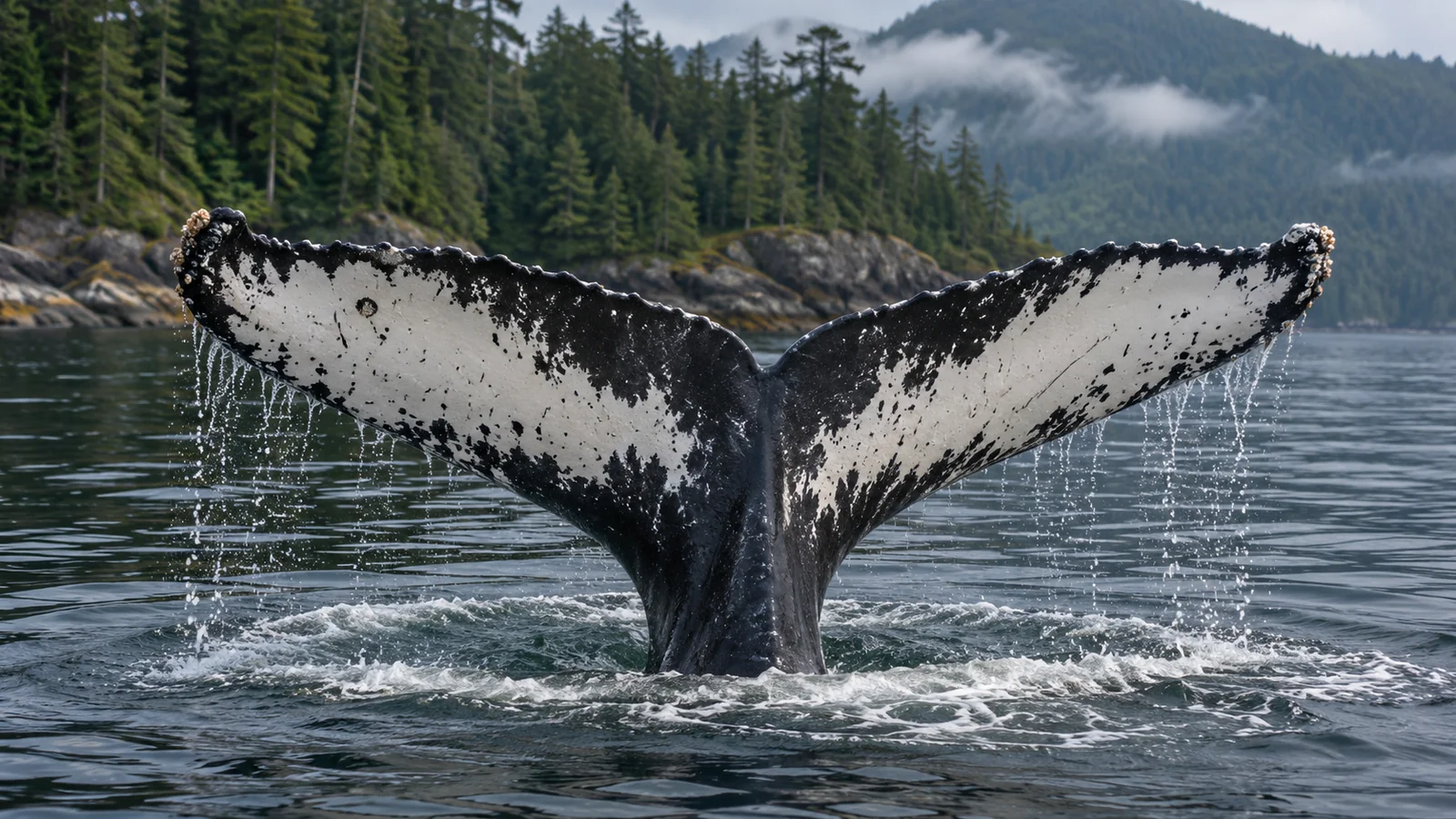
The underside of a humpback whale’s tail carries a combination of light and dark markings, edge shapes and scars that can help researchers recognise that individual. When the whale lifts its tail, a clear photograph can preserve those features. Researchers compare the photograph with known whales in a catalogue and attach confirmed matches to a record of where and when the animal was seen. In British Columbia, those records have helped connect whales seen in coastal feeding areas with sightings on distant wintering grounds. They can also answer a question as specific as whether two humpbacks photographed in Discovery Passage were a mother and her calf.
Look at the underside and the trailing edge
A whale’s tail has two broad lobes, called flukes, with a notch between them. Watch the underside when it rises above the water. It may look nearly black, mostly white or somewhere between. The details researchers compare include the position of a dark area, the shape of the border between light and dark, and the outline along the edge. Scars or individual indentations can add clues. The combination makes a photograph useful even when its overall colour looks similar to several others in a catalogue. NOAA humpback profile
Suppose you see a humpback raise a mostly dark tail with a small pale patch near one tip. If you can see both halves, you can check how far the patch sits from the central notch and whether it reaches the trailing edge. A second image might also show a small indentation near that spot. Think of these as positions on a map. The marks become easier to compare when you can describe where they are in relation to the outline. A fleeting impression that the tail was dark will leave many more possible matches.
The whale may lift its tail for less time than you expect. A wave can obscure the lower part of the image, and a tail angled away can hide one half. If you come away with a partial frame, keep it. Another person’s photograph from the same encounter may provide a view you missed. If you are looking through binoculars, try noting where the pale areas sit as the tail rises. That gives you something concrete to look for again if the same whale surfaces nearby.
What the letters in a BC humpback ID mean
The Marine Education and Research Society, or MERS, coordinates the Canadian Pacific Humpback Collaboration. The collaboration uses a code that groups flukes by the amount of white on their undersides. In the coding scheme, X indicates less than 20 per cent white, Y indicates 20 to 80 per cent white, and Z indicates more than 80 per cent white. The number identifies an entry within that series. The series letter helps describe a general appearance. Recognising an individual still depends on matching features within that pattern. MERS population studies
Conger is one example. The whale’s BC code is BCY0728. The Y puts its fluke in the middle pigmentation group, and the nickname comes from a marking that suggested an eel to the researchers who catalogued it. A nickname gives people something easy to remember. The code is the better reference when someone needs to look up the animal in the catalogue or compare two records. An international database may also give the same whale its own identifier. A confirmed photograph can link those records even though the labels differ. DFO migration study
From a suggested match to a research record
A local research team can compare a photograph against images of whales known from its study area. When groups share data across regions, the pool of possible matches can grow to many thousands. A North Pacific research collaboration combined 39 curated catalogues and public contributions in a single dataset. Its image recognition system made it possible to compare photographs across a much larger collection. Trained reviewers checked the matches, helping prevent two different whales from being joined into one record. North Pacific dataset study
A good match needs more than a strong resemblance. Consider two mostly white flukes with dark rims. The proposed match gets stronger if the rims change width in the same places and if the outline shows the same small irregularities. If a major feature is missing in the new image, a reviewer can ask whether the angle or a wave hid it. An image may remain unassigned if the visible details cannot settle the question. Keeping that uncertainty in the record protects later analyses that depend on treating each whale as a separate individual.
The date and location are part of the scientific record. Several images from one day can show the same encounter and give a reviewer more angles to work with. A match months later represents a separate observation. The difference matters if researchers want to understand which whales return to an area, where else those whales have been seen or how frequently an individual shows up in photographs. A sharp image with no reliable date or location can help with recognition while leaving questions about the encounter unanswered.
Two examples of what matching photos can establish
Cirque and Glacier in Discovery Passage
In January 2017, photographs taken near Quadra Island showed two humpbacks together. MERS recognised Glacier and documented the second whale, later called Cirque. Cirque’s size, appearance and proximity to Glacier suggested that Cirque might be her calf. The team kept the relationship open because it had only one documented encounter of the two whales together. MERS Cirque account
Years later, another photographer shared an archive containing images from September 2016. Those earlier photographs showed the same small whale closely associated with Glacier. In 2024, MERS reported that the additional encounter had resolved the question and identified Cirque as Glacier’s first known calf. The missing evidence came from an older photograph that had yet to reach the team. If you have photographs from past trips, check whether you can still recover their dates and locations before deciding they are too old to submit.
A BC sighting matched to wintering grounds
In a study of humpbacks encountered in Canadian Pacific waters, Fisheries and Oceans Canada and collaborators compared encounter records with photographs from around the North Pacific. Among the matches, they identified 13 whales documented both in Canadian Pacific waters and in Central American wintering areas. Some of those same individuals also had records from Mexico. In the report, the table for those animals puts the Happywhale and Canadian IDs side by side so readers can follow the matches across the two systems.
Those records establish locations where an individual was observed. The whale may have travelled through places with few photographers, or surfaced without giving someone a view of its tail. A match between two places gives scientists a connection they can test against other records. The database does not show the exact route between them. A whale with no winter match in a catalogue may simply be missing a photograph from that part of its travels. Photo coverage matters when researchers use the collected matches to describe patterns across a population.
The same records can be useful when researchers look for signs of harm. A series of photographs may show when a visible mark first appeared, which can narrow the period in which an injury happened. Someone comparing the images still has to distinguish a scar from natural pigmentation and consider whether the earlier photo showed the same area clearly. A catalogue of photographed survivors also leaves out animals that were never photographed again. That makes the series valuable for following known individuals, while any estimate of how often whales are injured across the population needs more evidence about which encounters and whales were sampled.
When the whale keeps its tail underwater
MERS also uses the shape and markings of dorsal fins to help identify humpbacks. The fin is on the back, well ahead of the tail, and may show during a surfacing even if the tail stays submerged. A photograph that shows the fin with some of the surrounding back gives a reviewer more context than an isolated crop of the tip. Keep both views if you have them. A fin photograph can be worth contributing even if you are unsure whether it contains enough detail to make a match. MERS data submission
MERS has also used markings around the mouth to recognise some whales while they trap-feed. That behaviour can offer researchers a view of the open mouth while the fin and tail are difficult to see. Mouth markings are useful when the team has reference images to compare. From a visitor’s perspective, an unexpected view can still be worth recording. Keep the wider frame if it shows what the whale was doing or helps someone follow which individual the close crop belongs to.
How to share a photo from a BC whale watching trip
If a humpback raises its tail during a Campbell River whale watching tour, take the photograph from where you are and follow your guide’s instructions. From shore, a long lens may help you keep both fluke tips in the frame. On the water, check the current Fisheries and Oceans Canada rules and read MERS’s guidance for submitting photos. A usable image depends on the whale’s angle and the conditions. There will be encounters where you can enjoy watching the whale without getting a frame that can be matched. DFO viewing guidance
Keep the original file and gather the date, time, location and photographer’s name. If the camera clock or location tag is wrong, note what you can verify and say where the uncertainty lies. If you have several images, choose the clearest underside view and include a fin view if available. MERS’s contribution page links to a form for sending photographs and sightings. If a photo belongs to someone else, ask them to submit it or obtain their permission before sending it.
You can use the same habit of noticing features even when no photograph turns out. While the whale is in view, watch for the overall light and dark balance and one distinctive edge detail. After the encounter, write down what you saw before comparing your impression with a named whale. If you’re still choosing a departure point, see our Vancouver Island whale watching guide. A dated note also gives you a record to share with the person who took the photograph or with a researcher who asks for the original.
Questions about humpback fluke identification
Does a photograph have to show the entire tail?
A full view gives a reviewer more reference points. A partial view may still be useful if it preserves a distinctive patch, scar or section of the trailing edge. Send the original frame if you have it, and include another view from the encounter when one shows a different part of the animal.
Can a tail photograph reveal a whale’s age or sex?
A fluke photo can establish which whale was seen if it matches a known record. Information about age or sex comes from other evidence in that whale’s history, such as an encounter when it was known to be a calf. A pigmentation code describes the underside of the tail. It carries no age or sex field.
Should I report the sighting if I have no usable photograph?
Yes, a sighting can still support other monitoring. Ocean Wise accepts sightings through WhaleReport, which helps inform alerts for large vessel operators. Record the time and place as accurately as you can and indicate uncertainty about the species or group size. Use the MERS contribution page when you have images for the humpback identification effort.