
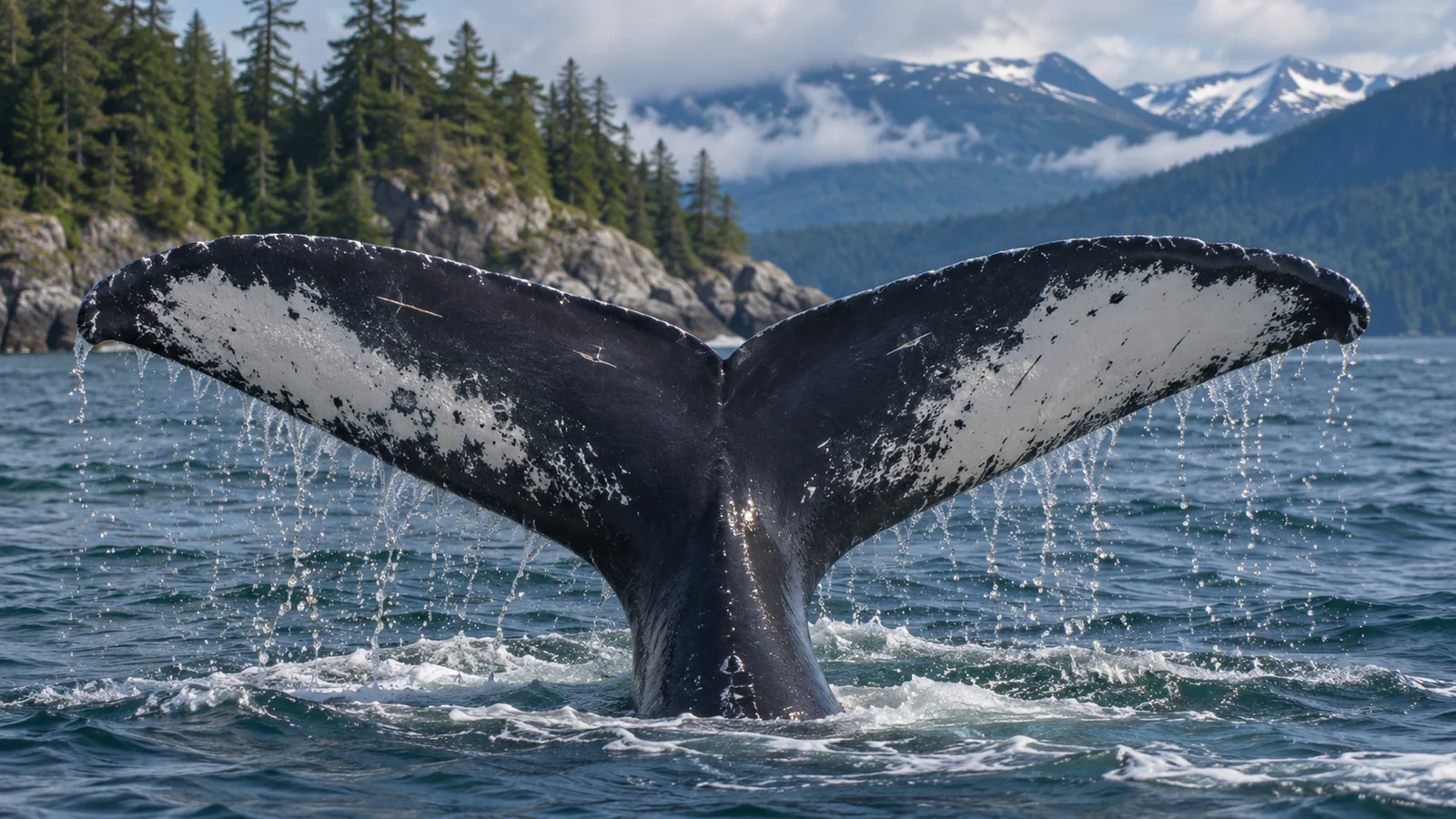
A scar on a humpback whale can tell researchers that the animal survived an injury long enough for a mark to remain. Its shape and location can sometimes point to an entanglement, a predator encounter or another cause. Older photographs of the same whale can help establish when the mark appeared. A single pale line may give much less information than a series of dated images. If you notice a mark on a humpback near Campbell River, start by describing where it was and what it looked like. That gives a guide or researcher a better starting point for judging what the image supports.
Why researchers pay attention to where a mark appears
A humpback’s flukes are the two lobes of its tail. The caudal peduncle is the narrowing part of the body ahead of them. Lines can leave distinctive marks around the peduncle or along the leading edge of the flukes after an entanglement. Other injuries can appear on the back, flippers or elsewhere. The place where a scar appears is one clue to how it may have formed. A photo that shows the whole visible area gives reviewers useful context for a close view of the mark. Canadian North Pacific humpback whale status assessment
When you look at an image, check how the whale is positioned. A view of the underside of the flukes can show pale marks and the outline of the tail. A side view may show part of the peduncle as the whale arches into a dive. The area that stayed underwater has no usable evidence in that photograph. A researcher can distinguish a visible area with no scar from an area that was never seen clearly.
A mark can also have more than one use. A nick in the edge of a fluke may help identify an individual. A series of marks around the tail can prompt a question about an injury. Identification tells the researcher which whale’s records to compare. Interpreting the injury requires separate evidence about when the mark appeared and which patterns could plausibly have caused it.
What different patterns can suggest
Scar studies use descriptions such as direction, spacing and body location to evaluate possible causes. Several parallel lines on a fluke can fit a pattern researchers classify as killer whale rake marks. A line that crosses the peduncle in a particular way can be consistent with contact from gear. Marks associated with vessel injuries can differ in size and arrangement, and some collisions leave little visible evidence for a later photo. A category in a study represents a set of criteria and sometimes a level of confidence. North Pacific research on rake marks in humpbacks · Study of humpback scar patterns in aerial images
An older photograph can help distinguish pigmentation from a mark that appeared later. A pale area visible in every clear image may be a persistent part of the pattern. A new mark on the same body region in several later photographs deserves closer comparison. Lighting, a film of water or the angle of a fluke can change the appearance from one frame to another. A series of images from similar angles helps a reviewer see which feature persisted.
Check the words a research team uses. “Consistent with entanglement” means the mark fits the study’s criteria. “Documented entanglement” may refer to an observed incident with gear visible. If both pieces of evidence refer to the same identified whale, they can support a stronger conclusion. For example, MERS has shared British Columbia cases that include images of whales with visible gear and documented injuries. The evidence available for those cases may exceed what is available for an unknown whale with one scar. Marine Education and Research Society examples from British Columbia
How before-and-after photographs narrow the date
Imagine that researchers have a clear photograph of a whale’s left fluke from one summer and another from the next. A scar is absent in the first image and visible in the second. The records can establish a period during which it appeared. If the whale travelled between several areas in the interval, the two photos leave the location of the injury uncertain. A dated incident report or an additional clear photograph could narrow the window.
If the first image is poorly lit or cuts off part of the fluke, the conclusion is weaker. The mark could have been present and hidden. Reviewers often need a clear view of the relevant region before using a photo as evidence that an injury was absent. That can reduce the number of comparisons they can make. A study that excludes poor images may report fewer whales with usable photographs than the total it documented during the season.
A healing sequence provides another kind of record. A later image might show the position of an injury more clearly, even if the whale’s appearance changed as it healed. A series can also document whether a mark faded or remained distinctive. When a guide describes an old injury, ask whether the whale was photographed at the time or whether the inference comes from what the healed mark looks like. The two kinds of evidence support different degrees of certainty.
Why researchers report how many photos were usable
Canada’s status assessment describes a British Columbia sample from 2017 in which 142 humpbacks had photographs suitable for evaluating possible entanglement scarring. Of those, 68 had marks on the peduncle or flukes consistent with a previous entanglement. The denominator is the set of adequately photographed whales in that sample. The percentage describes visible scar evidence under that method. It does not directly estimate the number of entanglements that occurred that year.
A single whale can bear several marks from one event or from events at different times. Counting scars and counting individuals answer different questions. If a paper says a proportion of sampled whales had marks, check whether it counted an animal once when any qualifying mark was present. The same rule needs to be used when you compare it with another study. A report about new scars developing over a period is another kind of measure.
There are also gaps the photographs cannot fill. An animal that died during an incident would not return to be photographed with a healed scar. An animal that survived might have no persistent visible mark or might carry an injury in a part of the body outside the photo. Scar evidence can reveal events missed by incident reporting, while remaining incomplete in ways that researchers have to account for.
Why the camera viewpoint changes what is counted
Boat-based photographs frequently show the back, fin and flukes when the whale surfaces or dives. Aerial images can sometimes show broader areas of the body. A New York Bight study used aerial images to examine how different scar patterns appeared in different body regions. This is an example of what another camera angle can add. Its estimates concern the study area and animals in that research. They should not be substituted for results from a British Columbia photo sample.
Suppose one project scores marks on the tail and another scores marks across much of the body. The second has more places to look for injuries. It could find a higher proportion of whales with marks even if the animals experienced similar conditions. Differences in classification and the dates of the photographs can also affect the result. Before comparing percentages, check which body regions were visible and what counted as a usable image.
The same principle applies to photographs taken on a trip. A clear dorsal view can document the position of a mark on the back. It may give you little information about the underside of the flukes. A photograph can still be worth keeping when it shows only one useful region. Include the date and location and retain the full frame so someone can see which part of the whale was visible.
How to handle a sighting near Campbell River
If you see an old-looking scar, ask the guide which feature caught their attention and whether the whale is known. A pattern may help with identification or support a cautious interpretation of a past event. It can take time to compare images, and the whale may only expose the area once. Observe from the position set by the crew. You can learn how the feature was read without trying to get another view. Eagle Eye’s Campbell River whale watching tour
A whale with possible gear attached or a fresh injury calls for prompt reporting. In British Columbia, let the crew know immediately if you are on a tour. Fisheries and Oceans Canada’s Pacific Observe, Record and Report line is 1-800-465-4336. Keep the applicable distance and leave any response to authorised teams. A scar that appears healed and an active incident provide different information, but an uncertain sighting of possible gear is worth describing to the crew. DFO Observe, Record and Report
If you want to learn what humpbacks and other marine animals can look like from the boat, use the operator’s wildlife guide before the trip. The most informative part of a sighting might be how the whale raised its tail, which surface of the flukes it exposed or how the guide recognised an individual. Those details can be useful regardless of whether a visible mark can be explained. Eagle Eye’s guide to marine wildlife on whale watching tours
How to describe a mark in a trip journal
Give the body region first. Then describe what was visible, including the number or arrangement of lines if you could see them clearly. A note such as “several pale, parallel lines near the outer edge of the left fluke” lets someone else understand the basis for your description. If the guide suggested a possible cause, record that separately. You can keep a useful record without turning the appearance of the mark into a definite account of what happened.
When evidence from an incident and a scar can be linked
Suppose responders document a line crossing a particular part of a whale’s body, and the animal is later photographed with a healed mark in the same place. An independent match to that whale’s fluke or another reliable feature can connect the two records. The documented incident helps explain the mark. In a different case, researchers might start with a similar-looking scar and have no incident report for that animal. Similarity gives them a reason to compare the cases and a basis for using a cautious classification.
A photo record can sometimes show the extent of an injury better after healing, when several parts of the whale are visible. It cannot recreate any gear or interaction that went unobserved. Keeping the incident record alongside the images preserves which details came from witnesses and which came from later interpretation.
Frequently asked questions
Are all white marks on a humpback scars?
Humpbacks also have natural differences in pigmentation. Dated photographs from similar angles help researchers see whether a mark was always visible or appeared after an earlier encounter. Some images leave the distinction unclear.
Can an entanglement scar show where an incident happened?
A healed mark may be consistent with contact from gear. Determining where the contact occurred generally requires an incident report, a closely dated sequence or other evidence of the whale’s location at the time.
Do parallel lines prove an orca attack?
A group of lines can fit criteria used by researchers to identify likely rake marks. The location, spacing, orientation and image quality all matter. A photograph can support an inference without showing the attack itself.
Does a whale with no visible scars have no history of injury?
An injury can leave little visible evidence or occur on a body region that a camera never captured. A scar study describes what could be assessed from the views available.