
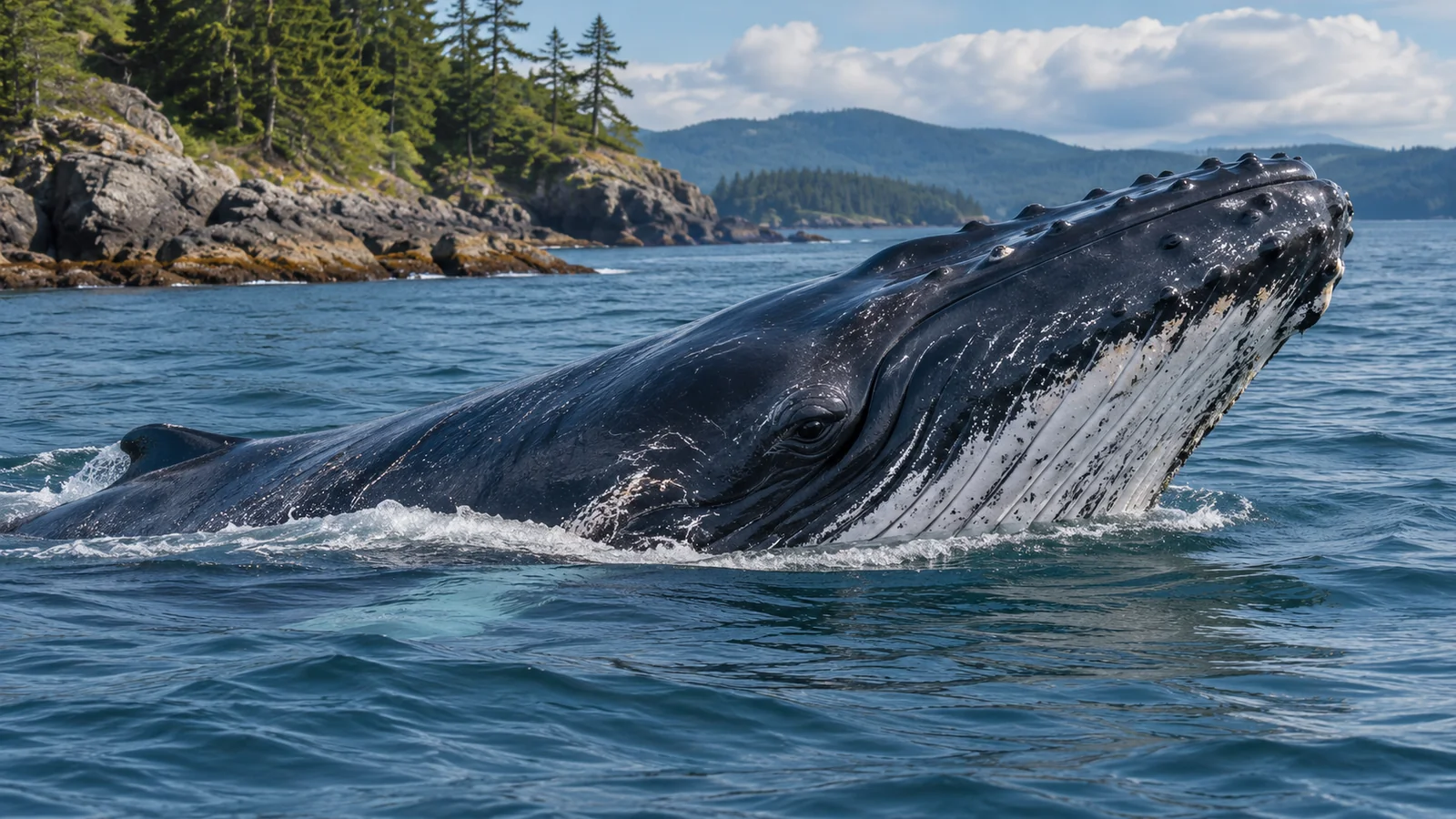
A trap-feeding humpback may hang almost motionless at the surface with its mouth open. Off northeastern Vancouver Island, researchers with the Marine Education and Research Society have documented some humpbacks doing this when juvenile Pacific herring are in small, diffuse schools and diving birds are pursuing them. Fish gather near or inside the whale’s mouth, and the whale may turn or sweep a flipper to direct them before closing its jaws. From a distance, the first clue can be an open mouth that remains in place. The behaviour makes more sense when you watch the fish, birds and whale as parts of the same encounter.
A feeding tactic that begins with a small school
A humpback can lunge through a dense patch of fish with its mouth open and take in prey along with water. In the conditions described by researchers off northeastern Vancouver Island, trap feeding gives some whales another way to catch juvenile herring. The fish may be spread out in smaller groups. Instead of making the fast approach typical of a lunge through a dense school, the whale waits with its mouth open at or near the surface. Some individuals turn or move their pectoral flippers during the sequence. Marine Education and Research Society’s trap-feeding study and footage
The order of events matters. Look for the whale’s position before the mouth closes. Is the head holding roughly in place? Do small fish gather near it? Are birds actively diving around the patch? One open-mouth image can show a moment in the sequence. A view that begins earlier gives observers a better chance to see whether the whale rushed into the school or waited for fish to gather.
A trap does not have to catch every fish to be useful. By holding an open mouth in a place where prey collect, the whale can take advantage of the behaviour of fish trying to escape other predators. The researchers compared this approach with lunge feeding and discussed how it could help whales make use of smaller schools. Whether a given encounter involved a successful catch may still be hard to tell from a boat. Peer-reviewed study on trap feeding
Why diving birds matter to the scene
Common murres and rhinoceros auklets are among the diving birds the research team observed around the juvenile herring. These birds pursue fish underwater. Herring can be driven near the surface, where gulls may also try to pick them off. Fish that collect close to or inside a whale’s open mouth are responding to a scene with several predators. The whale can take advantage of that movement. Describing what the fish did is more useful than saying they chose the whale’s mouth as a refuge with a known intention. Marine Education and Research Society’s account of filming feeding humpbacks
Pay attention to how the birds are moving. Gulls hovering or landing on the surface tell you something different from diving birds disappearing beneath it. Both can be present around the same school. Some fish may flash near the surface while much of the action remains hidden. A short encounter gives you only part of the interaction. You can still record which animals were visible, what they did and which part of the sequence the guide interpreted.
Changes in bird activity can alter what happens next. The research team’s filming account describes occasions when shearwaters disrupted concentrations of juvenile herring, making surface feeding harder to observe. It is an example of why a busy patch of water does not always develop into the same feeding event. Several predators can respond to the same prey, and their actions can change how the school is distributed.
How to distinguish trap feeding from other methods
In a surface lunge, a humpback moves into prey and opens its mouth to engulf water and food. The approach can be quick and produce a large disturbance. With trap feeding, the whale may hold the open position for a more noticeable interval. Small movements of the head or flippers can occur while the mouth stays open. Compare the motion before the mouth opens and while the whale feeds. The size of the splash is an unreliable shortcut on its own.
Bubble-net feeding involves bubbles released underwater in a pattern that helps concentrate prey. Researchers have documented both solitary and coordinated use of nets in Canadian Pacific waters. An organised pattern of bubbles before a lunge is a different clue from a whale remaining at the surface with an open mouth. Different techniques can occur in the broader region, and an animal can surface in a way that leaves much of the underlying behaviour hidden. Research on bubble-net feeding in Canadian Pacific humpbacks
All of these methods bring prey into the mouth. A humpback’s baleen is involved once it has taken in food and water. The feeding tactic describes how the whale gathers or approaches the prey, while the baleen helps retain food as water leaves the mouth. If a guide says a whale trap-fed, ask about the behaviour that happened before the filtration stage. That is usually where the distinguishing clues are. NOAA humpback whale profile
What researchers learned from known individuals
Scientists began documenting trap feeding off northeastern Vancouver Island in 2011. Their published analysis reports two confirmed animals in the initial year and sixteen by 2015. Those are counts of individuals documented doing the behaviour during the study period. They tell us that the recorded set of trap feeders grew. They do not identify the moment each whale first used the tactic, because some events happen beyond the researchers’ view.
The researchers compared how frequently whales were seen and how they associated with known trap feeders. Their work examined whether those social relationships could help explain the spread of the behaviour. An animal that spends time near a trap feeder may have an opportunity to observe it. The researchers also considered ecological conditions. Two whales can use the same food patch because both respond to similar prey, and that proximity needs to be interpreted alongside the rest of their encounter histories.
This is where individual recognition makes a difference. Imagine that observers see trap feeding on three days. If the same whale did it each time, the records show repeated behaviour by that animal. If three different whales did it, they show that at least three individuals used the tactic. Researchers need to distinguish those possibilities before they can investigate how the behaviour spread. A named or numbered whale in a published account is tied to the identification evidence behind the record.
How a wide-open mouth complicates photo identification
Humpback photographs often show the underside of the flukes when a whale lifts its tail. During trap feeding, observers may see a head and open mouth with little view of the flukes or dorsal fin. MERS has described building a reference collection of mouth markings to help recognise animals from these encounters. That gives their team another set of features to compare when the familiar parts of the whale stay out of view.
A photograph can be useful even when it fails to identify the individual. An image that preserves how the animal was positioned and what other species were nearby can help describe the behaviour. A sequence of photographs can show whether it remained roughly in the same place. If the whale later dives and raises its flukes, that image can potentially provide separate evidence of identity. Keeping the pictures in order makes it easier to see which parts of the encounter each one documents.
Notice how this changes the choice of photo. For a field record, a wider image that includes birds and the water around the head may answer a question about behaviour. A closer crop can reveal the shape and marks on the jaws. Both views can be useful when recorded from the viewing position already available. If you are on a boat, follow the crew’s direction and let the encounter develop at the whale’s pace.
Put a Campbell River sighting in context
The study area in the original research was off northeastern Vancouver Island. It provides a regional example of what humpbacks can do under particular conditions. It does not give a timetable for the waters near Campbell River or establish how often the behaviour occurs along a specific tour route. Local sightings depend on where whales and prey are and what can be observed from a responsible position.
On a Campbell River trip, a useful question is what the guide saw first. If the guide noticed diving birds and then spotted an open mouth holding in one place, you have the beginning of a description. If the crew saw a swift lunge into a tight school, the interpretation may be different. Seeing only a patch of agitated water may give you a chance to learn about the prey and birds even if the whale’s method remains uncertain. Eagle Eye’s guide to wildlife seen on a whale watching tour
Consider the whale watching departure if you want more time to observe how different animals use the local marine environment. Birds, fish and whales can each contribute a clue to the activity you encounter. Even when a whale’s exact feeding method is unclear, you can ask how the guide reads the surface and what evidence would support a more specific description. Eagle Eye’s Campbell River whale watching tour
What the research can tell us about effort
An open mouth held at the surface looks less vigorous than a rapid lunge. The study discusses an energetic explanation for the tactic, particularly when juvenile herring are spread through a small area. To evaluate that idea, it helps to think about the whole feeding event. The whale must position itself, wait or move, take in prey, filter water and then continue searching. A motionless-looking moment is only one part of that sequence.
A dense school could give a whale enough food to make a fast lunge worthwhile. When fish are more diffuse and already being driven toward the surface by other predators, the costs and benefits of the two approaches may change. A visitor can see why that question matters without calculating the cost of a single mouthful. It is a question about which tactic a whale uses under particular prey conditions. Researchers can compare documented encounters to see whether the expected conditions actually occur with each behaviour.
Frequently asked questions
Do all British Columbia humpbacks trap-feed?
The behaviour has been documented in some individuals. The original study examined whales off northeastern Vancouver Island and considered why the tactic might spread among them. Its scope does not establish how common the behaviour is in other groups or feeding areas.
Can a humpback use both trap feeding and lunge feeding?
Yes. Researchers describe northeastern Vancouver Island humpbacks that lunge on concentrated schools of juvenile herring, with some individuals also using trap feeding when the prey is less concentrated. The fish and the behaviour of other predators can change the conditions within a single area.
Does a whale with an open mouth always indicate trap feeding?
Look at how it moved before and during the opening. The position of the whale, nearby fish and birds, and how long the mouth stayed open all help. An observer may miss the start of the encounter and be unable to tell which tactic the animal used.
When did researchers first document the behaviour?
The research team began documenting it off northeastern Vancouver Island in 2011. That is the start of the documented local record described in their study. The year does not tell us when a whale first tried the behaviour out of sight of people.
A later observation can extend that history by documenting a different individual, place or combination of prey conditions.