
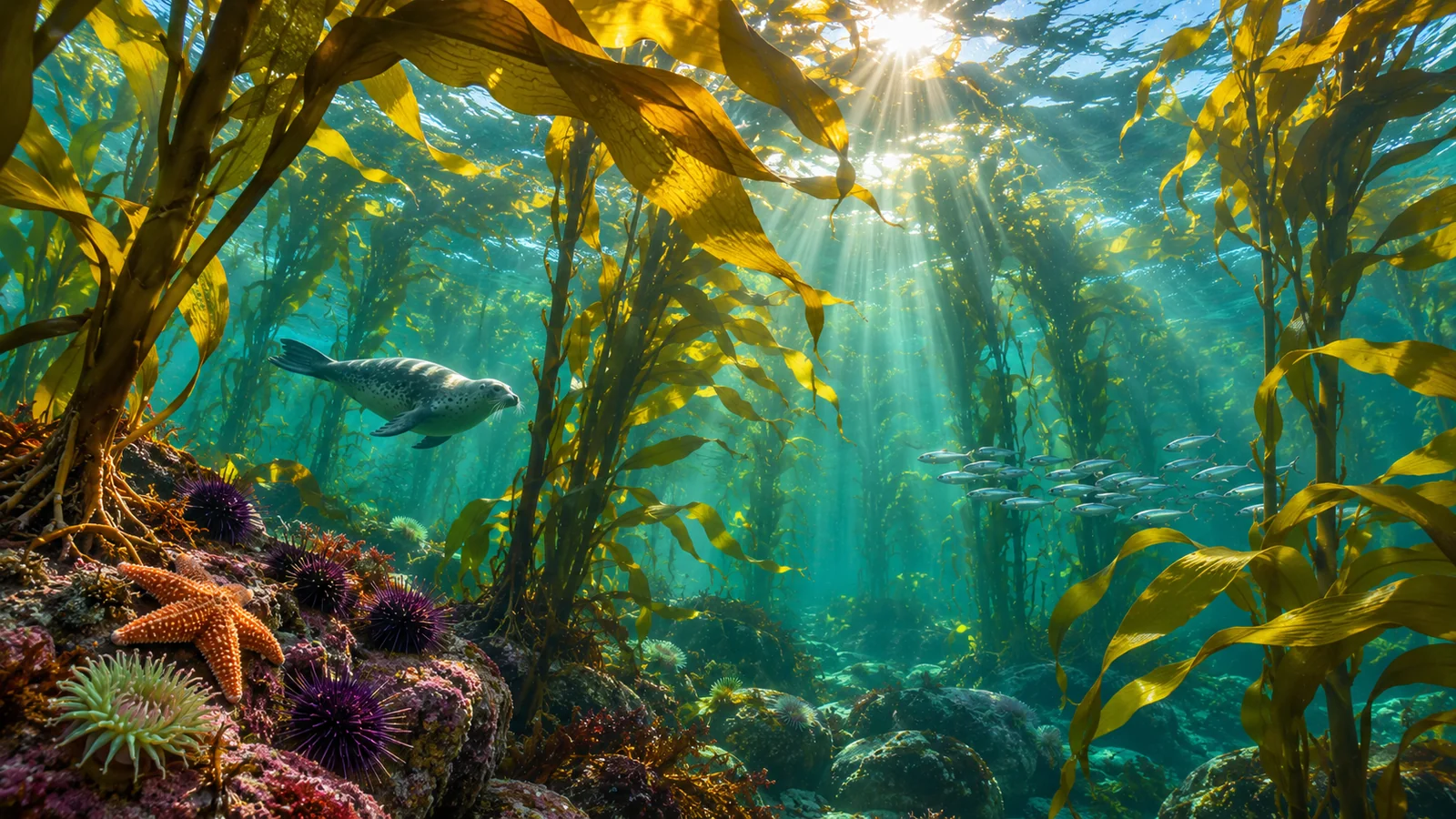
A kelp forest gives coastal fish three-dimensional habitat above a rocky reef. Some fish move among the blades to find shelter or food. Others use the edges and openings between plants. Juvenile rockfish can settle in kelp after spending their early lives in open water. Research off western Vancouver Island has documented changes in diet and body condition after young black rockfish settled in giant kelp forests. The canopy you see from shore or a boat is the top of a habitat that can extend many metres below. Parks Canada kelp forests overview Markel and Shurin, study of kelp forests and rockfish
To understand what kelp does for fish, imagine tracing one stalk down from the surface. Near the top, leaves move in the brighter water. Farther down there is space between stalks, and near the bottom there are holdfasts, lower-growing algae and the features of the reef itself. A fish has several possible places to hold position, look for prey or get out of sight. Which one it uses depends on the species, the stage of its life and what’s happening around it.
The canopy adds habitat above the reef
Canopy-forming kelps on the BC coast include bull kelp and giant kelp. Both are large brown algae, but they grow differently. A bull kelp has a long stalk that rises to a float with blades attached near the surface. Giant kelp can carry many blades and floats along its branches. The resulting forests can give fish different patterns of cover and open water. Below the conspicuous plants, smaller algae may also grow on the reef. A kelp forest includes the spaces among these layers. Study of kelp persistence off western Vancouver Island
Start at the canopy. Near-surface blades can form a patch of cover overhead. Light and the movement of the blades change the view from below. Openings let fish move between denser parts of the bed and the adjacent water. A floating canopy can also conceal fish from someone on a boat looking directly down. The presence of visible leaves tells you the kelp reaches the surface there. It leaves most of the fish’s movements hidden.
Farther down, stalks add vertical structure, and the reef below offers its own ledges and crevices. Holdfasts keep the kelp attached to rock. Other small organisms can occupy spaces around those structures. Fish may move through the forest at different heights and use the bottom for a different purpose from the canopy. A kelp bed with the same surface area as a neighbouring bed can still provide a different amount and arrangement of habitat below.
Shelter depends on the size of the fish
For a young rockfish, blades and other structures can break up open water and provide places to stay out of sight. A large fish searching for prey may use a different part of the same bed. It can pass along an opening, search near the bottom or wait near an edge. The arrangement of the kelp affects both animals. Cover can be useful to a small fish at the same time that the outer edge offers opportunities to a predator. DFO research priorities for BC nearshore algae Study of rockfish in giant kelp forests
Imagine a dense group of stalks beside open water. A small fish can cross the boundary and return within moments. The fish may choose that part of the bed because prey reaches it there, because it can retreat between the stalks or because current conditions make the position useful. A single observation of a fish near the edge shows its location at that moment. To decide why it was there, you’d need to watch what it did and compare conditions in several parts of the bed.
Exposure also varies with water movement. A current can stream the blades to one side, opening some spaces and partly closing others. The top of the bed may shift visibly while the holdfasts remain in place. A surface outline can look larger or smaller depending on how the fronds lie and how much water is over them. When researchers compare underwater habitat, those changing conditions help explain why measurements of the canopy alone answer only part of the question. Kelp distribution and persistence study
Kelp connects fish to food in several ways
A fish does not have to bite kelp to benefit from it. Small animals can live on blades or among the structures on the reef, and fish can eat those animals. Material from kelp can enter a food web as it breaks down or is consumed by other organisms. Moving water also carries prey through the forest from elsewhere. A fish feeding at a kelp edge can therefore have access to a mixture of prey tied to the reef and prey that arrived from the surrounding water.
The study off western Vancouver Island used evidence about diet and the sources of carbon in fish tissues. Young black rockfish showed a shift towards kelp-derived carbon after settling in kelp forests, along with changes in trophic position and body condition. The carbon result traces a contribution through the food web. It does not require the fish to have eaten the kelp directly. That distinction is helpful when you read an account of what a habitat provides. A reef can supply the place to feed and also contribute material to the prey fish eat there.
A shoreline observer may see the end of that chain. A bird catches a fish above a kelp edge and carries it away. You can describe the bird’s location and the moment of capture, while the fish’s previous feeding history is hidden. The research fills in some of those earlier steps. It shows why a kelp forest can influence food well beyond the blade visible at the surface.
When young rockfish settle into coastal habitat
Young fish often use a different habitat from adults. Some rockfish spend an early period in open water before settling into nearshore habitat. Researchers monitoring western Vancouver Island compared young-of-the-year rockfish recruiting to kelp forests and eelgrass meadows over several years. They found a number of species and species groups using nearshore habitats. The distribution was variable, and the habitats mattered in different ways for different fish. Western Vancouver Island young rockfish recruitment dataset
Settlement is an important transition. A fish goes from using open water to occupying a particular habitat where it can find cover and prey. If researchers count newly settled fish in a kelp forest, they can learn which species used the site at that stage. Following those fish over time is a separate task. Fish can grow, move or die, and another survey may find a different number. An effective nursery provides opportunities during a life stage that the fish may later spend elsewhere.
The word “rockfish” also covers many species. The results from juvenile black rockfish tell you about that species under the conditions studied. Copper rockfish and other species can use nearshore environments differently. A forest can matter to several fish without serving the same role for each. A survey that distinguishes species and size classes gives a clearer picture than a count of all fish pooled together. Young rockfish recruitment research dataset
Why the neighbouring habitat matters
A kelp forest is usually part of a larger pattern of rocky bottom, open water and patches of other habitat. Fish can use the boundary between a reef and a sandy area, or move between kelp and eelgrass where the habitats occur nearby. The distance between habitats and the conditions along the route can influence how easily a young fish can use both. A dense patch surrounded by open water gives a different set of choices from a forest that grades into other cover. University of Victoria research on rockfish and nearshore habitat connections
If you look at a map of kelp around western Vancouver Island, check how the forest was mapped. Researchers have used historical charts and modern satellite imagery to study where canopy-forming kelp persisted or changed. Those sources give valuable records of the places where kelp was visible or charted. A diver who counts fish within a bed answers another question at a smaller scale. The map shows where there could be habitat. The survey shows which fish were observed in the part that was sampled.
Compare what different surveys can see
A diver searching between stalks can spot fish that are invisible from a vessel. Visibility still depends on the water and how well a fish blends in among the blades. A stationary camera records a more limited area and can watch for longer. If a school swims past the camera twice, a researcher has to decide how to count those passes. A series of visits made using the same method gives a better basis for comparing forests than a single look from different distances or heights. Studies that identify fish separately can also reveal a shift that a total count would hide.
The same logic applies across seasons. Kelp structure can change as it grows or as waves remove blades and stalks, and young fish arrive at different times. If a spring visit shows many small fish in one part of the bed and a later visit shows fewer, the result could reflect movement, growth, changes in cover or differences in what was visible. Matching the date, depth and methods helps researchers isolate those possibilities. If you compare two photographs, check whether they show the same side of the bed and how much of the water column was visible. A side view below the canopy can show layers an aerial photograph leaves hidden.
What to look for around Campbell River
From a public shore viewpoint, follow the visible kelp edge along a rocky point. Look for gaps and for places where a blade appears below the surface before it reaches the main patch. If conditions let you see fish, watch where they enter or leave open water relative to the edge. The shoreline view can reveal movement through one small part of the habitat. Note where the canopy ends relative to the rock before the current changes the shape of the visible patch. It can also hide fish in shadow or deeper water. Keep the observation tied to the area and conditions you could see.
Eagle Eye Adventures’ guide to wildlife beyond whales around Campbell River describes animals that can draw your attention to the same coast. A bird or seal may come into view near the kelp, while the fish below remain hidden. If you’re observing from a boat, follow the crew’s directions and keep the kelp bed undisturbed. A wider look at the shoreline and water can help place that brief animal sighting in the habitat around it.
Does more surface kelp always mean more fish?
A larger visible canopy can indicate more kelp habitat, and fish can respond to the habitat available to them. The number of fish also depends on species, depth, conditions and the time of year. An aerial image can describe the surface cover while missing the vegetation and rock below. To compare fish habitat across places, combine the surface view with information about the layers underneath and the fish that use them. That comparison is the difference between seeing the top of a kelp forest and understanding what it offers a fish. Rockfish study off western Vancouver Island