
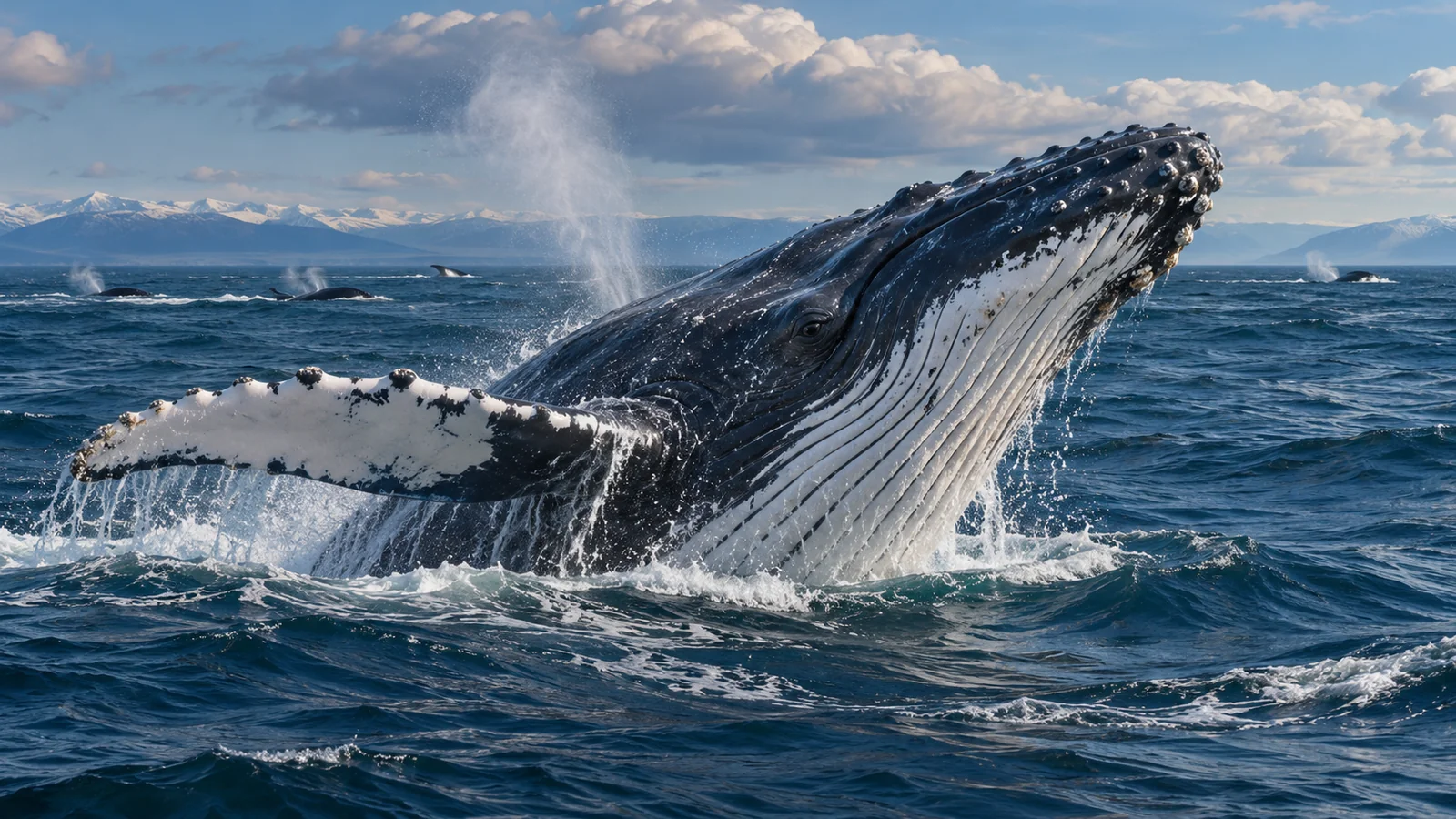
Many North Pacific humpbacks that feed in British Columbia spend part of the winter in breeding waters around Hawaiʻi or off the Pacific coast of Mexico. Researchers established those connections by recognising individual whales on both sides of the journey. The matches show broad patterns in where animals go and some striking examples of individual variation. They also leave stretches of the journey unobserved. A whale feeding near Vancouver Island could have a history in one of several wintering areas. To understand where it goes, start with the individual’s records and then see how they fit into the larger North Pacific pattern.
Two parts of the annual cycle
In the North Pacific, many humpbacks use productive northern waters during the feeding season and travel to lower latitudes during the breeding season. The annual movement links areas with different roles. In feeding areas, whales can take advantage of concentrations of prey such as small schooling fish and krill. In the wintering areas, they mate and give birth. Breeding-season activity extends across several months, and the timing of a particular whale’s travel can vary. Canadian North Pacific humpback whale status assessment
This division helps explain why two people in different places can have very different humpback encounters. Someone on Vancouver Island may see a whale moving through feeding habitat, taking long dives or surfacing around prey. Someone in a wintering area may observe social activity or a female with a young calf. The behaviour visible in either place belongs to that encounter. Taken together with records across seasons, these places give researchers a way to follow the whale’s year.
The timing in a map caption may describe the months when researchers expect a broad pattern. It does not give every whale a departure date. Some humpbacks stay in feeding areas beyond the main period and others may arrive earlier or leave later. For a trip planner, departure availability and conditions around Campbell River are more useful than treating the entire species as though it moves on the same timetable. Eagle Eye’s guide to whale watching seasons in British Columbia
Where British Columbia’s humpbacks have been matched
The Canadian status assessment identifies Hawaiʻi and Mexico as the main wintering destinations documented for humpbacks that use Canadian Pacific waters. The Mexican records include areas off the Pacific mainland, southern Baja California and the offshore Revillagigedo Archipelago. A label such as “Mexico” on a broad map can therefore cover several widely spaced areas. The name of the region may be sufficient to describe the basin-wide connection. The precise site matters when you want to understand how two studies grouped their observations.
There is structure within British Columbia’s feeding range as well. A Fisheries and Oceans Canada analysis used matches from Canadian Pacific waters to examine spatial differences in connections to wintering areas. Read those results as patterns across studied regions. British Columbia’s coastline covers many channels and feeding sites, and the relative representation of wintering origins can differ across study areas. A conclusion for a larger feeding region cannot identify the destination of a single whale seen near Campbell River. DFO analysis of migratory destinations from Canadian Pacific waters
Across the wider North Pacific, breeding has also been documented in areas including Central America and the western North Pacific. The basin-wide set of destinations is useful for seeing how large the system is. For a question about a whale photographed off British Columbia, give more weight to the records that directly link Canadian Pacific feeding grounds with a wintering site. The answer can be broader or narrower depending on the evidence behind it. NOAA’s North Pacific SPLASH project archive
How a whale’s photograph becomes evidence of movement
A humpback’s raised tail flukes can expose a distinctive combination of markings and edge shape. Researchers compare images from different encounters to determine whether they show the same animal. When the photographs are good enough to support a match, a sighting from a northern feeding area and a sighting from a wintering area establish a connection for that whale. An encounter with a clear place and date has more value for migration research than a photo for which those details have been lost.
The connection can be much harder to find than the basic idea suggests. A whale may never raise its tail where a photographer can see it. Images from one region may live in another organisation’s records. The animal may also have gone to an area that received little field effort in the year of interest. The North Pacific SPLASH project brought researchers together across feeding and wintering areas and used common methods to make more comparisons possible. This coordination is particularly important when the question spans an ocean.
A pair of matching photographs establishes the places where the animal was recorded and, with good dates, the order of those observations. A line drawn between the two places makes the connection visible. The whale’s actual route may have been longer or more complex. A tag track can show intermediate positions during the period when a device reports them. Photo records and tag tracks therefore provide different kinds of evidence about the same journey.
Why a feeding ground can contain whales from different wintering areas
Imagine two humpbacks photographed on the same day near Vancouver Island. A research team later matches one to Hawaiʻi and the other to Mexico. Both animals used the same feeding area on that day. Their earlier winter records point to different places. A productive feeding area can bring together whales with different migration histories. The seasonal destination of one animal does not follow from its proximity to another.
The reverse can also happen. A wintering area can contain animals from several feeding grounds. Researchers may match one photographed there to British Columbia and another to Alaska or another region. If you see a broad label describing whales by the wintering area in which they were documented, remember that those whales can disperse across multiple feeding areas. The part of the annual cycle used to name or group the animals matters.
Published records also describe unusual individual movements. One study reported humpbacks documented at both Mexico and Hawaiʻi breeding grounds during the same winter. The two records for each individual establish that the whale reached both areas in a single season. These cases show what is possible and help scientists investigate connections between wintering groups. They should be understood in the context of the broader pattern of regional use, where repeated use of a wintering area is common. Research on same-winter matches between Mexico and Hawaiʻi
What you can learn from the absence of a match
Suppose a whale appears regularly in photographs from British Columbia but has no identified wintering record in the dataset you are reading. Its destination remains unknown in that set of records. Researchers may have missed the whale, obtained images unsuitable for a match or been unable to compare photographs from the relevant area. The record can still show a strong history of feeding-area use. It simply answers a different part of the migration question.
Coverage can influence comparisons between destinations. A wintering area with many photographs creates more opportunities for matches than an area with fewer photographs, all else being equal. When reading a report that compares numbers of matches, look for its account of search effort, years and geographic coverage. An identified whale may also appear in several years of the study. A count of matched individuals, a count of sightings and a count of matched destinations can describe different results.
Check whether the map shows a single project or draws on multiple collections. A map that spans the ocean may bring together work from teams that began at different times or observed different parts of each season. Reading the collection notes helps you see why researchers may have confidence in a broad connection while leaving individual places, seasons and travel routes open for further study.
Bring the migration question to Campbell River
A boat trip gives you a view of one place and a short period in a humpback’s year. If a whale is seen, ask whether the crew recognised it and whether any of its other records are known. A guide may know it has been seen previously in nearby waters. The winter destination may be unknown. If you see an animal travelling, note its immediate direction without drawing a long route from that observation. A whale heading through a channel may still be using feeding habitat. Eagle Eye’s Campbell River whale watching tour
You can also use the trip to learn what makes a photograph useful. The best image for research may be a clear view of the underside of the flukes, with the date and location preserved. A photograph of the whale’s back can still record the encounter and help you remember what you saw. The animal may never raise its tail during the viewing period. Follow the crew’s directions and work with the view that the whale and conditions provide.
How researchers decide whether two destinations are linked
The most straightforward match is a pair of clear photos with reliable dates and locations. One shows a whale in a feeding area and the other shows the same whale on a wintering ground. The observation is strongest for the individual. When many matches connect the same two regions, researchers can begin to assess whether that link is common in the sample. To turn it into a population claim, they also have to consider which whales and places could have been missed.
A different question is whether a whale uses one region consistently over several years. Two records from one winter do not address that by themselves. A longer history with winter records from several years shows more about repeated use. If the whale is documented in both Hawaiʻi and Mexico, check whether the records come from the same breeding season, separate seasons or a record with an uncertain date. Each possibility says something different about how that individual moved through the North Pacific.
Photographs from the same feeding area over many years add another piece of evidence. They can show that an individual returns to part of the British Columbia coast repeatedly, even if its winter records are scarce. Two whales with similar local histories may have very different winter records simply because one was photographed at the right moment in another region. Their catalogue entries preserve that difference in evidence.
Frequently asked questions
Do all British Columbia humpbacks winter in Hawaiʻi?
Hawaiʻi and Mexico are the two principal wintering destinations documented for humpbacks using Canadian Pacific waters. Individual matches and the coverage of the underlying research matter if you want to connect one whale to a particular destination.
Does a humpback use the same wintering area every year?
Repeated use of wintering areas is well documented. Researchers have also reported whales using more than one area, including examples photographed at breeding grounds off Mexico and Hawaiʻi in the same winter. The record for the individual whale is the strongest evidence for what it has done.
Can you determine a whale’s complete route from two photos?
Two photographs can connect the same individual with two dated locations. The whale’s movements in the interval remain open unless researchers have further sightings or track data. Look for how a study labels the lines on its map.
Does a late humpback sighting indicate migration has started?
A sighting establishes that a whale was in a particular area at that time. It may have been feeding, moving locally or travelling farther. Seasonal timing helps put the observation in context. Its actual destination requires evidence from another part of the journey.