
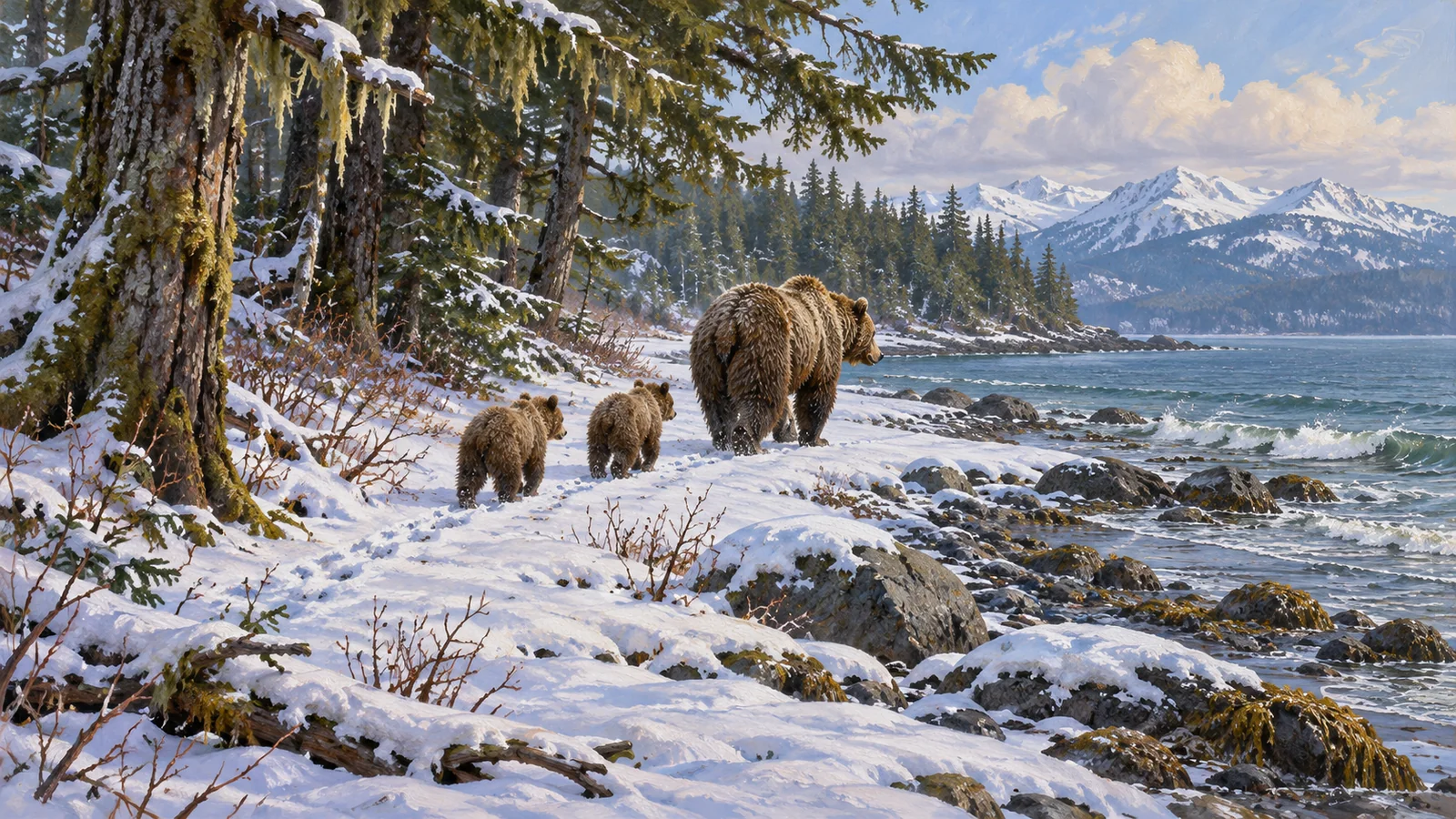
Grizzly bear cubs are born during winter in their mother’s den. They begin life small and dependent, nursing while the female relies on energy stored before she denned. The shelter gives the cubs time to grow before they start moving with her above ground. Birth and emergence dates vary among individuals and populations, so an example from the Canadian Rockies should be read in its regional context. The sequence is the same basic story: the mother arrives with reserves, the cubs develop on her milk, and the family enters spring with the cubs still dependent on her. Parks Canada grizzly biology
The first winter begins with the mother’s previous season
Grizzlies reproduce through a process called delayed implantation. After mating and fertilisation, the early embryo can remain unattached for a period before it implants in the uterus. Development that leads to birth takes place later. That separation helps explain why summer mating does not lead to an immediate summer birth. The female’s condition matters because she will have to support late pregnancy and then nursing while relying on her own reserves.
Autumn feeding therefore contributes to a cub’s first winter before the cub is born. A mother has to carry enough energy for her own needs and for reproduction through a period when she is generally not out foraging. A coastal bear may add reserves using salmon and other seasonal foods available in its range. The importance of a particular run depends on what the bear can access and what else it eats over the season. You cannot infer whether a female will have cubs from one feeding sighting, even if she is catching fish actively. Canadian grizzly assessment
The winter also asks different things of different females. A female with no young can draw on reserves for her own needs. A female supporting cubs also has to produce milk. Research on coastal brown bears on Alaska’s Kenai Peninsula found differences in body mass and composition around denning among females with different reproductive circumstances. It is one way to measure the cost of winter reproduction in the wild. It does not supply a fixed cost for a female in every coastal BC watershed. Coastal body condition study
What happens when cubs are born in the den
Newborn grizzly cubs are small relative to their mother and depend on her care. Parks Canada describes young born in the den in midwinter, then nursing on fat-rich milk as they grow. The den provides a sheltered space during the weeks when the young are least able to move through the landscape. If you have seen a photograph of cubs following a female in spring, those animals have already spent weeks developing before they took their first steps outside.
Early growth depends on the transfer of energy from mother to cub. Her milk is the young animals’ food, and producing it draws on her resources. The cub can grow during a period when food in the surrounding landscape may be limited or difficult to reach. That arrangement also means the quality of the shelter and the mother’s condition matter together. A protected space gives the family a place to remain, and her reserves support the time spent there.
Think of denning from the perspective of each animal. The female is conserving energy while supporting a litter. Each cub is growing and gaining the ability to move around, while depending on its mother for food and protection. Their needs change over winter. The newborn cub requires shelter and milk. A cub nearing emergence still needs care, but it will soon have to keep up as the mother starts to move through spring habitat. The den gives that transition time to occur.
Why a birth date is difficult to measure
Researchers rarely have a continuous view of a wild grizzly giving birth. To study timing without relying on direct observation, they can use instruments that record changes in a female’s activity or body temperature. A study of free-ranging brown bears in Scandinavia compared those records to estimate events around implantation and birth. In some cases the estimates from the two measurements matched, and in others the inferred dates differed. The study shows why a date in a research table may be an estimate derived from a pattern rather than an event a person watched. Brown bear reproductive timing study
A later study across four interior North American grizzly populations examined the interval between estimated birth and den exit. Researchers classified females by whether cubs were seen with them during their first visual observation after exit, where that information was available. Their results supported a trade-off between the time cubs have to develop and the energy their mother spends nursing in the den. The authors studied particular populations and used apparent survival based on later observations. The result helps explain why the interval matters without establishing an exact birth or exit date for a coastal bear. Grizzly birth timing study
Consider what researchers would need to establish from an ordinary sighting. If a female emerges with two cubs, the observation confirms that two young were present when she was seen. It does not give the day of birth. It may not show what happened between emergence and the sighting, or whether the observer could see every animal in cover. Adding a movement record and observations over time can help answer some of those questions, with uncertainty remaining where the evidence is incomplete.
What changes when the family leaves the den
Canada’s grizzly assessment describes pregnant females as generally entering dens earlier and emerging later than adult males. The timing varies with region and the animal’s circumstances. A female that leaves the den with young also has to travel at a pace the cubs can manage. In some coastal observations, mothers and young stayed near the den area for a period after emergence, particularly where early feeding habitat was nearby. Staying in a broad area still leaves room to move between shelter and forage. BC coastal habitat guide
The family’s first spring is a new stage. The female can begin feeding outside again. The cubs continue to depend on her and begin moving with her through the landscape. Parks Canada describes young learning to find and use seasonal foods while they stay with the mother over subsequent years. The process begins with following her and experiencing the places she uses. A young bear in its first spring has had far less opportunity to learn the landscape than an older dependent cub. Parks Canada bear family
A sighting later in the active season gives a different view of that development. A cub may be capable of following the female along a bank or pausing near her while she feeds. You can describe what the animals did together. Estimating the cub’s age precisely from size or deciding what it has already learned is harder. Visibility, distance and differences among individuals can affect your impression. A guide can help you describe whether the young appeared to be cubs of the year or older dependants while keeping any uncertainty clear.
Compare the first winter with the next one
The term cub of the year means a bear born during the most recent winter. A yearling has already lived through its first active season and returned to a den the following winter. The two ages can look similar at a distance, particularly if you see the animal only briefly. The difference matters when describing development. A cub leaving the den for the first time begins the spring after months of relying on milk in shelter. An older dependent bear has already spent an active season moving with its mother and encountering the foods she uses.
The distinction also matters in research. A female seen with yearlings is evidence that those young survived the previous summer as well as their first winter. If a researcher is asking specifically about survival soon after birth, they need observations tied to the first year and an understanding of when the family was first seen. An early count in open ground and a later count in thick cover may have different chances of revealing every young animal. Keeping observation conditions attached to the count makes those records easier to compare.
A visitor can apply the same care to photographs. Save a wider frame that shows the group if you already have one, and record the date and approximate location. A close view of a single young bear can preserve details of its appearance, while a wider view may show how it was moving in relation to the adult. Neither frame can establish a birth date. Together they can make it easier to describe the encounter accurately.
It can also help to note the stage of the active season. A photograph taken soon after spring emergence and one taken near autumn show animals at different points in their first year. If you compare size or movement across images, first check that you know the dates and whether the photographs show the same individual. Keep any age estimate separate from the date recorded on the image.
What can a visitor learn from a family sighting?
Eagle Eye Adventures’ grizzly bear expedition from Campbell River travels to mainland Toba Inlet and visits river viewing platforms with local Klahoose First Nation guides. It is an active-season experience. If a female with young is visible, keep the group in view from the platform and follow your guide’s instructions. Notice whether the young stay close when she moves or pause to investigate something nearby. You are seeing behaviour from one part of their year.
One good question for a guide is which places the family can use while staying near cover. An adult and cubs moving out of sight may simply have continued behind vegetation. The first animal to disappear is not necessarily the last one in the group, and a brief look does not establish how many were present. Giving the family room keeps attention on observing rather than getting a better view. If you are deciding when to visit, see the guide to BC grizzly viewing seasons for the broader active-season context.
Questions about grizzly cubs’ first winter
Are grizzly cubs born in spring?
Grizzly cubs are generally born in winter while the female is denned. A spring sighting can be the first time an observer sees the young. The cubs have already nursed and grown inside the shelter by then. The day they first appear in a photograph is therefore an observation date, rather than a birth date.
Does the mother feed the cubs salmon in the den?
The young nurse on her milk. Food she ate before denning may have contributed to the reserves used to produce it. This means a previous season’s feeding can matter to the cubs without any fish being brought to them.
Does a mother leave the den as soon as her cubs can move?
Den departure depends on more than the cubs’ ability to move. The mother’s condition, the development of her litter and seasonal conditions form part of the picture. Studies of birth timing and exit describe variation among individuals. A record of the family outside on a certain day cannot reveal every factor behind the timing.
Can I tell whether two small bears are siblings from one encounter?
If two young bears move with the same adult, you can record that association. A clear sighting can show who was present and how the group moved. Researchers and experienced observers may use earlier records to interpret relationships. For a visitor with one observation, describing the family group as it appeared is usually the most useful starting point.