
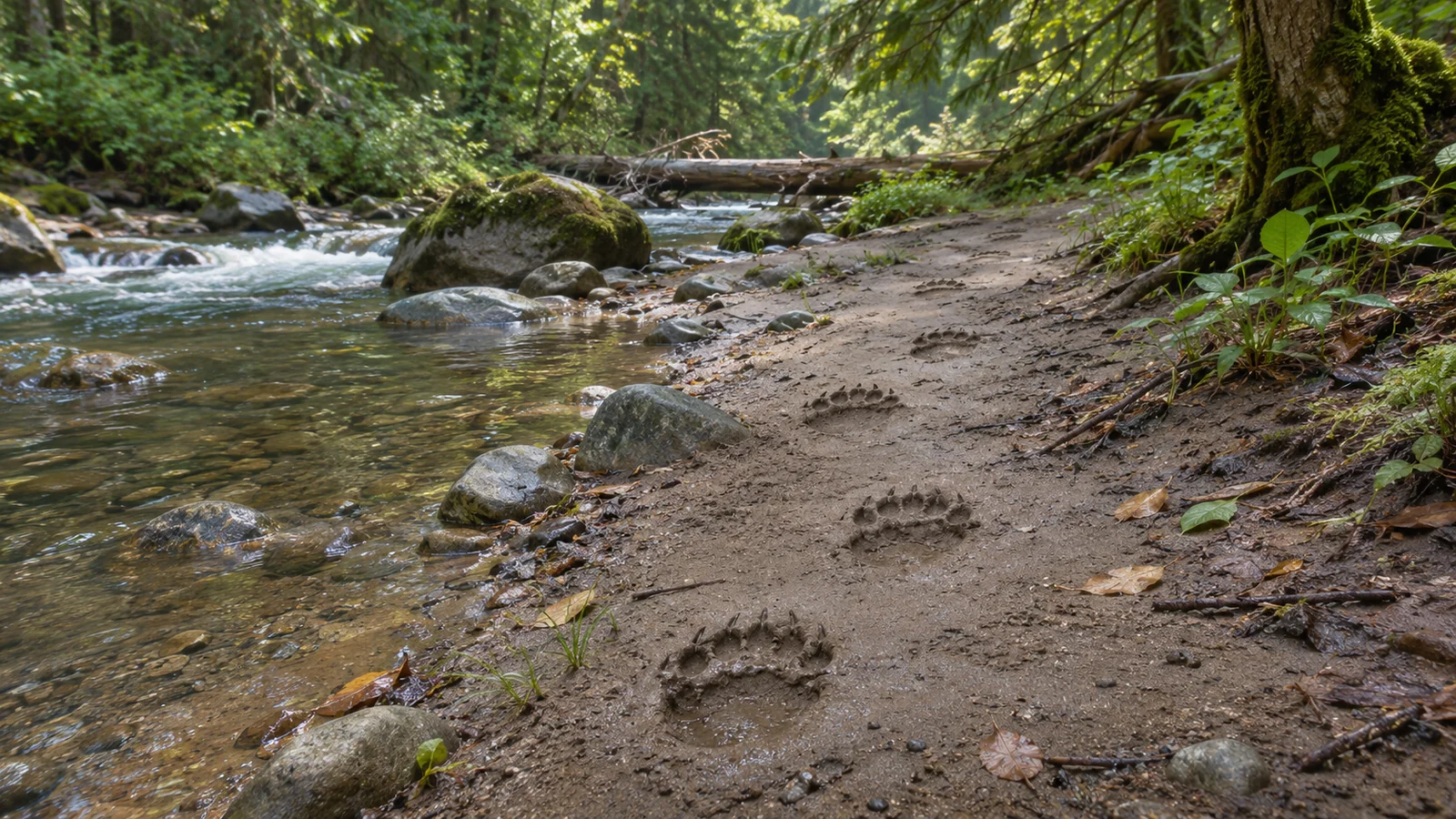
A clear front track is usually the best place to compare a grizzly bear with a black bear. Grizzly toes tend to sit close together in a relatively straight row. Black bear toes tend to form a more pronounced arc. Front claw impressions, when visible, generally sit farther from the toe pads in grizzly tracks. Use those features together and check that you are looking at a complete print. Wet sand, crumbling mud and overlapping feet can change what the track appears to show. If you find fresh bear sign, follow local safety guidance and leave the area. You can study a photograph afterward. National Park Service track guide
First, decide what the print actually preserves
A good print can show three distinct parts. The large impression behind the toes is the pad. Smaller impressions in front of it show the toes. Marks farther ahead may show where the claws entered the ground. On a hard surface, an animal can pass without leaving any clear print at all. Soft ground may preserve part of the foot while the rest sinks, slides or lands on a firmer patch. Before comparing species, identify which parts of the print are visible and which you would have to guess.
This matters because a partial print can create a convincing wrong impression. Four clear toe marks and a blank patch do not mean the animal had only four toes. The smallest toe may have landed on a pebble or at the edge of a depression. A streak ahead of one toe may be a claw mark, but it can also reflect movement as the foot left the ground. Give the most weight to features that repeat across clear prints you can already see from where you are.
An outline from above usually gives you a clearer view of relationships than a photograph taken at a shallow angle. If an existing photo shows a track from the side, the far edge can look foreshortened and the row of toes may appear more compressed. The angle matters less when the image is used to document that a print was present. It matters more when you are trying to compare the precise positions of toes and claws. You can leave that distinction in your notes instead of forcing an identification from the photograph.
Compare the toe row on a front print
Identify the pad and both ends of the toe row
In the National Park Service comparison, the grizzly or brown bear front toes are relatively close together and aligned in a straighter row. The black bear front toes are more separated and tend to follow a curve. The agency’s illustrated method uses a line beneath the large toe along the top of the main pad. The position of the smallest toe relative to that line differs between the two track shapes. Use the published diagram to orient the print before interpreting it. If either end of the row or the top of the pad is missing, the comparison has lost an important reference point.
A track can be turned in any direction relative to the trail. Rotate a photo so the toes are above the pad before comparing it with a reference. The straightness of the toe row should be judged relative to the rest of the foot, independent of how the photograph was held or the bear’s direction of travel. Some images are much easier to read once they are rotated. Rotation cannot restore a toe that never left a clear impression.
Keep the front and hind prints separate
The hind foot can leave a more elongated impression, while the front print usually has a broader pad without that long heel outline. When one print falls close to another, the two impressions can merge. An apparent extra heel or unusual row of toes may belong to a second foot. Where you cannot determine which parts came from the same step, set the print aside and use a clearer reference image. National Park Service field diagrams
Imagine a patch of soft sand with one broad front print and a second, elongated impression partly on top of it. You might be able to trace the outline of the elongated print while losing the toe positions in the broad one. The safest conclusion from the image may be that the prints overlap. A textbook outline of the hind foot does not supply missing information about the front print beneath it.
Use claw marks as supporting evidence
Grizzly front claws tend to leave marks farther ahead of the toes than black bear claws when the ground records them. Black bear claw marks can be close to the toes or absent. Measure the relationship between a mark and the toe it seems to belong to, rather than the distance from the mark to an unrelated edge of the print. If the marks sit in a separate line where the ground changes texture, inspect the photo for signs that they may have been made by something else. Parks Canada track comparison
Claw impressions are conditional on how the foot made contact. A light step on a firm patch may show toes and pad without claws. In mud, a sliding step can make a short mark look longer. If you have a clear straight toe row and distinct claw marks well ahead, the clues may support one another. If the toe row is unclear and all you have is a narrow scratch, the scratch carries much less weight. That is why the pad, toes and claw marks are best assessed as a set.
Size can be useful context if the image has a reliable scale and the whole print is preserved. It remains a poor rule on its own. A young grizzly can leave a smaller print than a person might expect, and prints can spread in soft material. If the broadest edge has crumbled, the width you see may exceed the original impression. For a record you can share, describe what was measured, such as the pad alone or the full toe row, so another person can understand the number.
What coastal surfaces do to tracks
Fine damp sand can hold details if the print has not been washed over. In coarser material, grains and gravel can interrupt the outline. Rain can round the edges, and water can collect inside the pad impression while erasing the smaller marks ahead. Vegetation can spring back after a foot lifts, leaving broken stems or pressure marks instead of a complete print. These are reasons to distinguish the shape of the foot from the shape of the mark it left.
Even two prints from the same animal can look different a short distance apart. One may be in wet silt and the next on a firmer patch. If the first looks broad and the second narrow, consider the difference in the surfaces before deciding they came from different bears. If two features are visible together on a complete print, give that record more weight than a combination assembled from impressions you cannot confidently attribute to the same animal.
On a tidal shore, a clear-looking impression does not provide a precise clock. Water and weather can change an older track, but its survival also depends on when that patch was last covered and how sheltered it is. A sheltered mark may look crisp after an exposed one from the same period has faded. Record when you saw the print and describe the conditions. Leave the time it was made uncertain unless you have direct evidence. Follow the guidance for the place you are visiting if the track appears fresh or other signs suggest a bear may be nearby. Parks Canada bear country guidance
Practise the comparison with photographs
The easiest place to learn the difference is with labelled images. Open the published front-track diagrams and find the broad pad before looking for claws. Notice how the smallest toe sits relative to the top of the pad. Then cover one side of the diagram and ask yourself whether you can still interpret the row. This shows why an incomplete print can give a strong first impression while leaving out the feature the comparison depends on.
Try the same exercise with a photo you already have. Begin by describing only the visible features. If you see a narrow pad and widely separated toes, check whether the scale and angle are reliable before deciding what those features mean. Then compare the original with any wider image that shows the surface around it. You may notice gravel, a shallow wash of water or another impression at the edge. Each provides context for why the print differs from a clean diagram. The exercise gives you a method to use later without staying near fresh bear sign.
Make a useful observation without following the tracks
Stay on the designated trail or viewing area and follow your guide or local safety instructions. Bear sign is a reason to pay attention to your surroundings. It is not an invitation to see where the trail goes. If you already have a photo, keep the original and note the time, general location and surface. A short note such as “possible front print, pad intact, smallest toe partly washed out” explains what someone else should look for. It also gives them a reason to treat the result as tentative.
The same approach applies when you have no photograph. Record the details that stood out while they are fresh, and mark which ones you are less certain about. A recollection of claw marks can be useful to a guide if it comes with a description of the surface and the visible toes. A report that says only “large grizzly print” gives the reader no way to check what led to that conclusion.
Eagle Eye Adventures’ grizzly bear expedition from Campbell River visits mainland Toba Inlet for platform viewing with local Klahoose First Nation guides. If signs are visible from the designated area, a guide can help explain what they can establish. The route offers a look at a river and its surroundings, where different surfaces preserve different evidence. For a wider look at where to plan a guided visit, see the guide to seeing grizzlies in Canada.
Questions about grizzly and black bear tracks
Does a print with no claw marks mean black bear?
Both the foot and the ground affect the impression. Black bear tracks often lack clear claw marks, while grizzly claws may fail to register on a particular surface. A missing mark offers less information than a complete toe row and clearly associated claw impressions. Look at the print as a whole before deciding how much weight to give this clue.
Can you use the toe line on a print with only three toes visible?
The comparison depends on the position of the large and small toes relative to the pad. If the key points are missing or unclear, there is no reliable way to draw the comparison line. You can still describe the part of the print that remains, including the shape of the pad if it is visible.
What is the best way to describe a track I cannot identify?
Start with the features you can see and the limits of the view. Mention whether the pad, full toe row and claws were visible, whether the ground had been washed or disturbed, and whether other prints overlapped. “Unidentified bear track” can be an accurate conclusion. A clear description can be more useful than a species name someone later has to verify. Share the original image when available.