
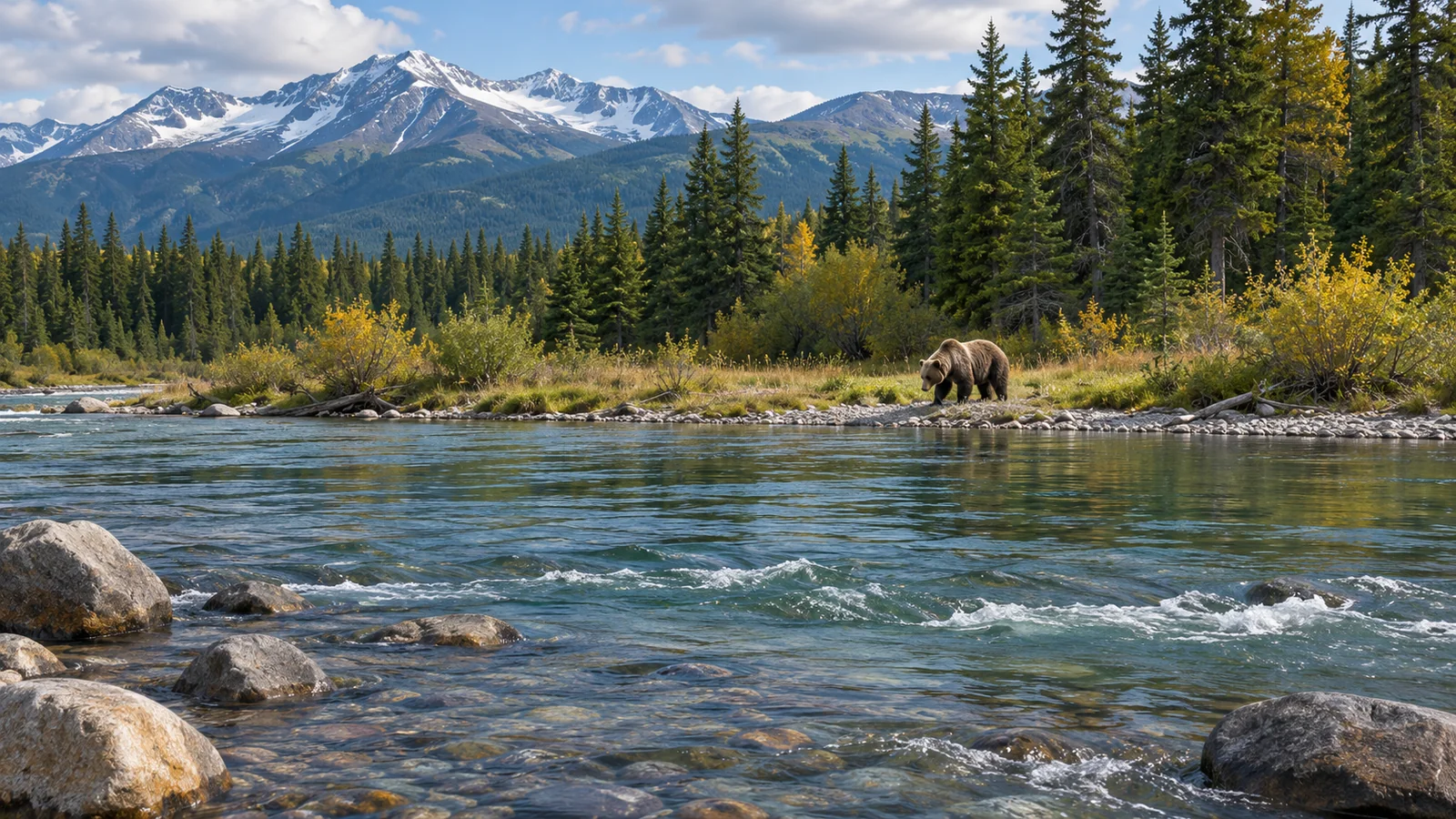
Guided viewing can change where grizzlies spend time and which parts of a feeding area they use. The response depends on the animals, the available food and how and where people are present. At Khutze on British Columbia’s Central Coast, researchers found that more people in the study area were associated with fewer overall grizzly detections and a shift towards more sheltered locations. Other BC research recorded differences in when some bears were active. These effects can be difficult to see from a viewing area. They help explain why guides manage the location, movement and timing of a group. Khutze field study
A visible reaction is only one possible response
When visitors can see an animal, they naturally pay attention to what it does in front of them. A bear might continue feeding, turn away, spend a short time looking in the group’s direction or leave the area. Those behaviours are observable when the animal remains in view. The bear can also respond before a person sees it. It might use cover, remain in another part of the watershed or approach the river when visitors are absent. Measuring those possibilities takes observations outside the immediate viewing encounter.
Picture a stretch of open bank near dense cover. A bear that continues to feed in the open will be easy for visitors to see. Another animal may feed along a sheltered margin, where the group gets only a brief glimpse. A third may remain elsewhere. The group’s experience depends on the behaviour of all three, but its observations mostly describe the first. This is one reason research that compares conditions with and without visitors can reveal more than a collection of accounts from successful sightings.
The scale of the question also matters. A bear leaving a spot does not necessarily leave the whole valley. It may move a short distance into cover. Equally, a brief look at the group does not reveal how often the bear had to interrupt feeding before the moment a visitor saw it. A researcher can look at responses over minutes, days or a whole season. A guide makes decisions for the encounter in front of them, drawing on what they can see and what the site’s procedures require.
What researchers found at Khutze
Khutze is in Kitasoo Xai’xais Territory. Researchers used camera traps at a range of sites in the watershed and compared bear detections with information about tours, habitat and salmon. Their study included a period without ecotourism in 2020 and a period with tours and alternating partial closures in 2021. They also recorded characteristics of tours so the comparison could consider how much human activity occurred, rather than treating all visits as identical.
When more people visited, researchers recorded fewer bear detections overall. Detections tended to shift towards more sheltered sites and away from open sites. The study found that patterns differed among groups of bears and with salmon availability. The researchers did not detect an effect of the alternating north and south closures on the measures they examined. They also reported that their activity analysis did not detect a shift in time of day in response to human presence. The results describe the specific management and ecological conditions studied at Khutze.
A camera detection is a record of a bear passing within a camera’s ability to record it. It is not a census of every bear in the valley. A change in detections can provide evidence about use of camera locations or the activity observed under particular conditions. When detections shift between sheltered and open sites, the pattern gives researchers something to examine about how habitat use changes. It takes separate evidence to establish whether bears ate less food or whether the population changed.
Why two sites can give different results
A study in the Glendale Cove area of Knight Inlet documented a different pattern. Its researchers saw changes in timing during the viewing day, with large males less active and females with cubs tending to be more active during that period. That study examined a particular arrangement of viewers, bears and a salmon run. The result offers evidence that bears of different ages or reproductive classes can respond differently in the same area. It does not provide a rule about which animals a visitor will see on any given day. Knight Inlet field study
The difference between the studies is useful. A finding about activity timing at one location can coexist with a finding about use of open and sheltered habitat at another. Animals face different choices about where and when they can feed. Researchers also measure different things. Some use a camera network and others make observations during defined periods. When you compare conclusions, check the local setting, the alternatives available to bears and the evidence used to describe their response.
Why where people stand can matter
In research at the Kulik River in Alaska, the relationship between people and bears depended on whether they shared the same river zones. The authors found no evidence of a change in the temporal pattern they measured when bears and people did not share zones. The study was conducted in a particular river system and cannot establish a universal separation distance. It illustrates why the position of a group relative to a bear and its route can matter, alongside the simple presence of people. Kulik River study
At a guided site, a fixed viewing area gives the guide a place to manage the group’s position. It can reduce the need for people to move around the habitat in search of a view. The fact that the group stands in one place does not establish the effect on every bear. A guide can adjust how the visit proceeds based on site conditions and instructions, such as asking visitors to remain still or to end an observation when the circumstances change.
It is also helpful to distinguish a response that looks quiet from one that carries little cost. A bear that slowly moves out of an opening has still changed its position. That may be a minor change if there are other places to feed nearby. Repeated interruptions at a productive site could matter more. Evaluating the cost requires understanding the alternatives the bear can use. A view from the platform shows only part of that landscape and part of the animal’s day.
What good monitoring looks for
Managers can check several things rather than judging the entire visit by the number of sightings. They may want to know where people go, what parts of the habitat remain quiet and how activity changes when groups are present. They can compare records over time while taking account of changes in salmon, weather and observation effort. A study that finds more detections on a particular day should also consider whether the conditions made animals easier to record on that day.
A useful comparison keeps the question and the measurement together. If the goal is to understand whether bears still use open habitat, observations at open and sheltered sites can help. If the question is whether they change when they visit a river, observations need to cover different times. If the concern is a loss of feeding opportunities, a record of presence can be paired with information about what the animals were doing. None of those measurements on its own captures the whole effect of a viewing programme.
Site managers can also check how a change works in practice. A new schedule may limit time in an area, but its effect depends on when tours actually run and what other activity occurs nearby. A closure can give bears more quiet time if people follow it and activity elsewhere does not overlap with the same habitat. Research can help test those possibilities. The results should be read in relation to the place where they were measured.
Track the conditions that could change the result
Suppose a site records fewer bears during a week with more tours. That could warrant a closer look, but fish numbers or water levels might also have changed during the same week. A useful monitoring record includes the conditions that give bears a reason to be there, as well as the human activity they encountered. When several factors move together, the data may support more than one interpretation. Repeating observations under different conditions can help managers understand which explanation fits more of the record.
There is also a distinction between the return of a bear after people leave and the return of its earlier activity pattern. One animal coming back tells you that it used the site again. Establishing that feeding resumed at the same rate would require another observation. Over a season, what matters can include how long the animal was able to feed, which alternatives it used and whether repeated interruptions occurred. Asking which of those outcomes a study measured helps you interpret its findings.
What a visitor can do during a guided trip
Eagle Eye Adventures’ Campbell River grizzly bear expedition visits mainland Toba Inlet for river viewing with local Klahoose First Nation guides. Follow the host’s instructions about where to stand, when to move and what to bring to the viewing platform. The guide may ask the group to pause while an animal is nearby or to leave an area when it is appropriate. Treat those decisions as part of the visit. Klahoose guest information
If an animal moves away, avoid trying to regain the view by changing position independently. You can ask what the guide observed and why the group is staying or moving. The answer may concern the bear’s direction, the shape of the bank or the need to keep space around an area. That conversation can help you understand how the host assesses the situation while giving the animal room to continue what it was doing.
You can also use quiet periods to notice what the bear has available. Look at the current, open gravel, vegetation and the route into cover. If the bear returns, you will have more context for how it is using the space. If it stays out of view, those observations still give you a way to understand the habitat. The guide to grizzly bear tours in BC offers wider context if you are comparing trips and locations.
Questions about guided grizzly viewing and disturbance
Does a bear that keeps feeding show the group had no effect?
It shows that the individual continued to feed while you could see it. You cannot infer how it behaved before arriving or after it disappeared. Other bears may use the same area differently. A longer record with observations under different conditions gives researchers more to work with.
Does a small group always have less effect?
Group size is one factor. Where people stand, how often groups arrive, the duration of viewing and the alternatives available to bears can all matter. A small group that moves into an important feeding area may present a different situation from a group that remains at a designated site. Follow the local guide’s instructions.
Are the Khutze findings a prediction for Toba Inlet?
They describe bear detections and behaviour in the Khutze study under the conditions the researchers measured. They give guides and visitors reasons to pay attention to cover, access and activity. The findings do not establish how bears respond at a different inlet with its own landscape and viewing arrangements.